
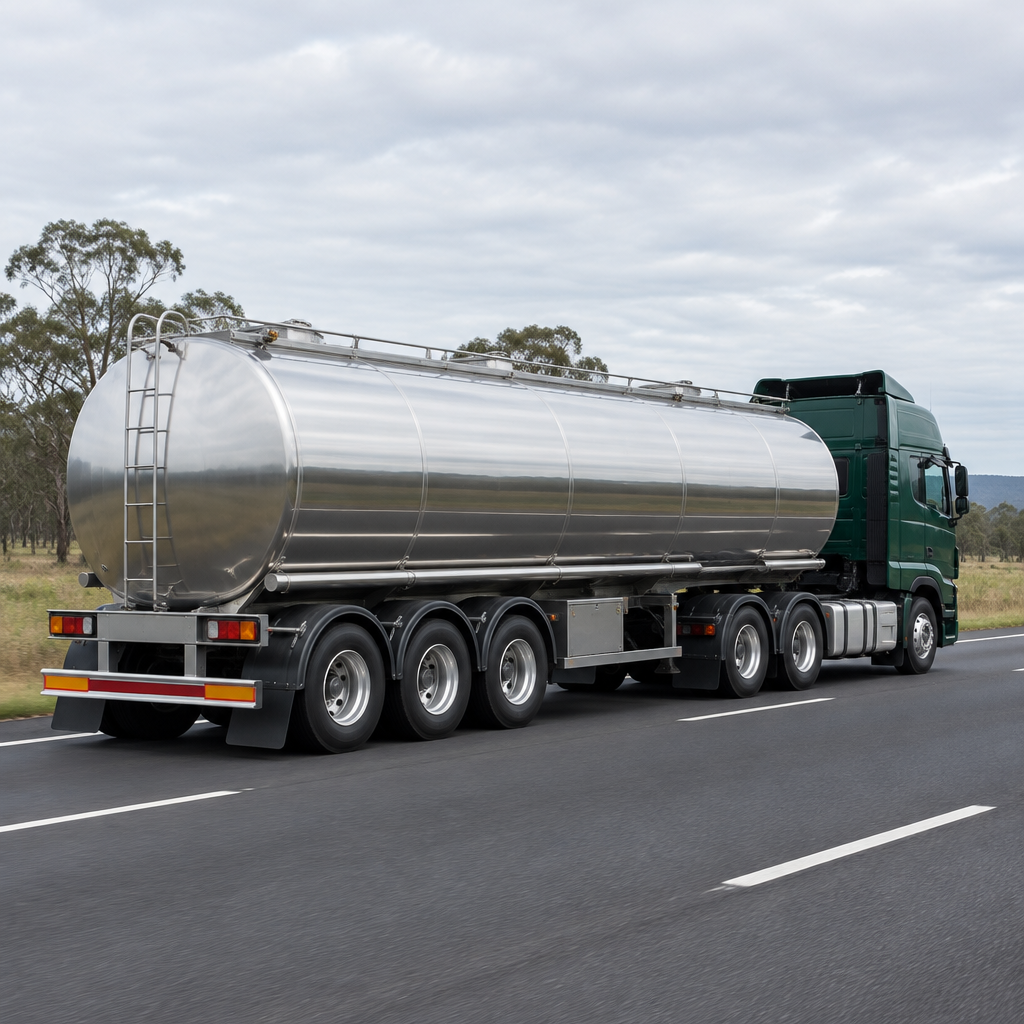
Yes, petrol is a Class 3 flammable liquid and a dangerous good under UN 1203 in New South Wales (NSW). Because it gives off ignitable vapour at everyday temperatures, moving petrol by road falls under the Dangerous Goods (Road and Rail Transport) Act 2008, the Regulation 2022 and the Australian Dangerous Goods (ADG) Code 7.9. What a load requires turns on four things: its packing group, whether it is bulk or packaged, whether it crosses the placard threshold, and whether the driver holds a NSW dangerous goods driver licence.
Quick Summary: Petrol (UN 1203) is a Class 3 flammable liquid in Packing Group I (Great Danger) because of its very low flashpoint. A load is bulk — and needs a DG driver licence (TLILIC0001) — when a receptacle holds more than 500 L capacity or 500 kg net mass. Packaged petrol below that needs no licence, but an aggregate Packing Group I quantity above 250 kg/L still makes it a placard load. In an incident: call 000, notify your employer, notify the NSW EPA Environment Line on 131 555, stay upwind, and keep ignition sources 15 metres clear.
What Is Petrol (UN 1203) and Why Is It a Class 3 Flammable Liquid?
In the ADG Code Dangerous Goods List petrol travels as MOTOR SPIRIT, GASOLINE or PETROL, all UN 1203, and sits in Class 3 dangerous goods in NSW — liquids giving off flammable vapour at 60°C or below.
Flashpoint is the minimum temperature at which a liquid releases enough vapour to form an ignitable mixture with air. Petrol has a very low flashpoint, far below the 60°C threshold that makes a liquid a Class 3 flammable liquid, so it gives off flammable vapour at ordinary temperatures. That vapour is heavier than air and gathers in low ground and drains, where a spark can ignite it well away from the container.
Petrol Packing Group: Why Petrol Sits in Packing Group I
The ADG Code sorts dangerous goods into three packing groups ranking the degree of danger: Packing Group I (Great Danger), Packing Group II (Medium Danger) and Packing Group III (Minor Danger).
For flammable liquids the bands follow flashpoint and initial boiling point. Petrol sits in the lowest, most dangerous band — Packing Group I — with hexane, naphtha, aviation gas and racing fuels. Packing Group II covers intermediate kerosene-class liquids such as kerosene, Jet A1 and white spirit; Packing Group III covers high flashpoint liquids such as heating oil and automotive diesel.
Because Packing Group I loads placard at a lower quantity than other loads, petrol reaches the 250 kg/L aggregate threshold well before a kerosene-class product would. Fuel blends vary, so confirm your product in the Dangerous Goods List and its safety data sheet; the working baseline for petrol is Packing Group I. The national rules sit in the ADG Code, which applies in NSW alongside state transport law administered by Transport for NSW.
When Do You Need a DG Driver Licence for Petrol in NSW?
The test is the receptacle, not the total load. Nobody may drive a vehicle carrying dangerous goods in receptacles over 500 litres capacity or 500 kg without a dangerous goods driver licence. The NSW EPA administers it, and the driver licence runs five years — separate from the vehicle licence, renewed annually. An exemption covers IBCs where total capacity on the vehicle is up to 3,000 litres and they are not filled or emptied on the vehicle.
Packaged petrol in 20 L jerry cans or 200 L drums is not bulk, so no driver licence is required — even when the aggregate load needs placards. That distinction trips up operators: placarding turns on aggregate quantity, licensing on receptacle size. Bulk drivers complete the two-day face-to-face DG Licence course (TLILIC0001, $618 all-inclusive) at Wetherill Park or Wollongong; staff who consign petrol without driving bulk loads can start with the online DG Awareness course ($196).
Placard Thresholds and Vehicle Marking for Petrol
A load is a placard load when it reaches any of these marks: a single receptacle over 500 L capacity or 500 kg net mass (any class, always placarded); an aggregate of Packing Group I of any class above 250 kg/L; or, for all other loads, an aggregate above 1,000 kg/L. For petrol the 250 kg/L line is the one that usually bites.
Placarded vehicles carry Class 3 placards — the red flammable liquid diamond, at least 250 × 250 mm with an internal line 12.5 mm from the edge — on the front and rear, and on either side of a multi-combination vehicle. Emergency Information Panels are required for bulk loads only, so a packaged-only placard load shows class placards rather than an EIP. Panels are 800 × 600 mm (down to 400 × 300 mm on an IBC or tank of 3 m³ or less) on the rear and sides of each unit carrying bulk, lower edge at least 450 mm above ground, and carry the proper shipping name, UN number, class diamond, HAZCHEM code and an emergency advisory number. See our guide to dangerous goods placards in NSW.
Reading the HAZCHEM Code on a Petrol EIP
The HAZCHEM code tells emergency services what to do first. The exact code for a product is assigned in the ADG Code’s HAZCHEM list and printed on the vehicle’s Emergency Information Panel, so drivers read it from the EIP rather than relying on memory — and never assume a code because the load “looks like petrol”. What the positions mean:
- First character — firefighting medium. 1 coarse water spray, 2 fine water spray, 3 foam, 4 dry agent (water must not contact the substance).
- Second character — protection and spill action. The letter sets protective equipment (liquid-tight chemical suit and breathing apparatus, or full fire kit and breathing apparatus) and whether to contain or dilute; some letters flag a risk of violent reaction.
- Trailing “E” — evacuation. A third character can only be E: a public safety hazard, where evacuation should be considered. Many codes are two characters only.
Knowing the layout lets a driver follow a fire officer’s directions and read an unfamiliar panel at a glance — but the panel, not memory, is the authority.
Safety Equipment and Transfer Controls for Petrol Loads
Every vehicle carrying a placard load must have fire extinguishers, at least three portable warning devices (triangles) complying with AS 3790, and the protective equipment required for the class. Road flares are never a substitute — an open flame at a petrol incident is an ignition source.
- Fire extinguishers. Flammable goods in tanks, bulk containers or IBCs over 10,000 L need 2 × 60B dry powder, or 1 × 80B plus 1 × 20B foam, in the load area, plus 1 × 10B in the cabin — the 20B foam unit belongs only to the 80B option. Packaged flammables need a 30B unit in the cabin or at the front of the trailer.
- Personal protective equipment. Commonly eye wash, chemical goggles, gloves and high-visibility clothing, with escape respiratory protection stowed in the cabin. Confirm the list with your employer.
- Transfer controls. The engine must stay stopped unless a vehicle-driven pump is in use, and the vehicle must be secured and attended. For Class 3 the supplying receptacle must be electrically bonded to the receiving one before transfer, and the vehicle must not be parked within 15 metres of a naked flame.
Drivers loading at a fuel terminal also need a current Safe Load Program (SLP) card, and the DG licence comes first — hold TLILIC0001 before sitting SLP.
Emergency Response for a Petrol Spill or Incident
Your employer’s transport emergency plan is the procedure to follow. It normally runs in this order:
- Shut down the engine and apply the parking brakes.
- Move upwind and assess the situation, including whether to evacuate.
- Call 000 — give the location and the UN number(s) carried.
- Notify your employer, or the prime contractor.
- Notify the state authority — the NSW EPA Environment Line on 131 555.
- Contain the spill if safe, keeping product out of drains and waterways.
- Set out your triangles, and keep other vehicles and ignition sources 15 metres clear.
Work from the cabin Emergency Procedure Guide: the EPG is the guide, the EIP is the panel. Once police or fire services arrive they take control — assist as directed. For general workplace guidance see SafeWork NSW.
Key Takeaways
- Class 3, Packing Group I: petrol is in the Great Danger band with hexane, naphtha, aviation gas and racing fuels.
- Licence by receptacle: TLILIC0001 applies only above 500 L or 500 kg per receptacle, with the 3,000 L IBC exemption.
- Placards by aggregate: Packing Group I loads placard above 250 kg/L — which implies no licence on its own.
- Diesel contrast: typical diesel above 60°C flashpoint is not DG; only low flashpoint diesel is UN 1202, Class 3, Packing Group III.
- HAZCHEM from the panel: first character firefighting medium, letter protection and spill action, E means consider evacuation.
- Emergency order: engine off, upwind, 000 with UN numbers, employer, 131 555, 15 metre exclusion, triangles.
Frequently Asked Questions
Is petrol classified as a dangerous good in NSW?
Yes. Petrol is a Class 3 flammable liquid under UN 1203 at every quantity, because its flashpoint is far below 60°C.
What packing group is petrol?
Packing Group I — Great Danger. Petrol sits in the low flashpoint band alongside hexane, naphtha, aviation gas and racing fuels, while Packing Group II covers intermediate kerosene-class liquids.
Do I need a dangerous goods driver licence to carry petrol drums?
Not for packaged petrol. The licence applies only where a receptacle holds more than 500 L capacity or 500 kg net mass, though a large aggregate load still needs placards and safety equipment.
At what quantity does petrol become a placard load?
At 250 kg/L aggregate, because petrol is Packing Group I — or immediately if any single receptacle exceeds 500 L or 500 kg.
What is the HAZCHEM code for petrol?
The code is assigned in the ADG Code’s HAZCHEM list and printed on the vehicle’s EIP, so read it from the panel rather than remembering it. The first character gives the firefighting medium (1 coarse water spray, 2 fine water spray, 3 foam, 4 dry agent), the letter gives protective equipment and whether to contain or dilute, and a trailing E means evacuation should be considered.
What is petrol’s flashpoint?
Petrol has a very low flashpoint, far below the 60°C threshold that makes a liquid a Class 3 flammable liquid. Check the safety data sheet for the grade you carry.
Is diesel treated the same as petrol?
No. Typical automotive diesel has a flashpoint above 60°C and is a C1 combustible liquid, not dangerous goods. Only diesel at 60°C flashpoint or below is UN 1202, Class 3, Packing Group III.
What fire extinguishers does a bulk petrol vehicle need?
2 × 60B dry powder, or 1 × 80B dry powder plus 1 × 20B foam, in the load area, plus a 10B unit in the cabin.