
Quick Summary: Every dangerous goods trip runs on paperwork plus equipment. Drivers of placard loads carry: a compliant transport document identifying the goods, the Emergency Procedure Guides in a marked holder, their driver licence and (for bulk loads) a dangerous goods driver licence, at least three AS 3790 warning devices, and the required fire extinguishers. Packaged dangerous goods above the placard quantity need placards and equipment — but no dangerous goods driver licence, which applies to bulk transport in receptacles over 500L or 500kg.
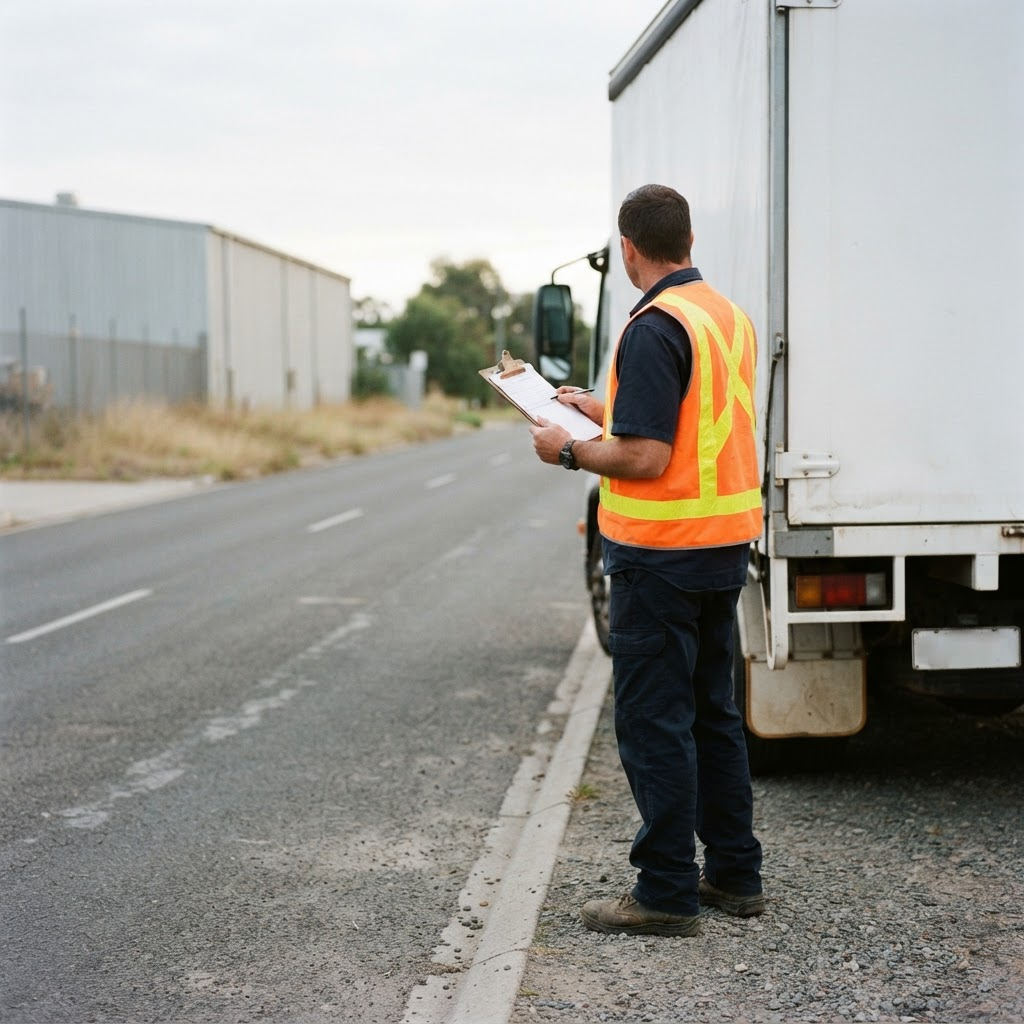
A dangerous goods load is never just freight — it is a compliance package on NSW roads. If an EPA officer, NHVR officer or police officer stops a placard-loaded vehicle, the documentation is inspected first. Here is the checklist of what the driver and vehicle must carry on every trip.
1. The Transport Document
The consignor must supply the driver with a transport document that complies with Chapter 11.1 of the ADG Code before the journey starts. In its required form, the dangerous goods information on the transport document includes:
- The proper shipping name of the goods
- The UN number
- The class or division (and any subsidiary risk)
- The packing group
- The quantity of each type of dangerous good
- The consignor’s details, and the consignee
The consignor certifies, by signing the transport document, that the goods are properly classified, packed, marked, labelled and described. Our guide to what a dangerous goods consignment note is and how to fill one in correctly walk through this in detail — errors here are among the most common compliance breaches.
2. The Emergency Procedure Guides and Holder
The vehicle must carry the Emergency Procedure Guide (EPG) for the dangerous goods on board, plus the EPG for vehicle fire. Both live in a holder marked “Emergency Procedure Guides” or “Emergency Information” in letters at least 10mm high on a white background. The holder should be mounted so it is accessible without entering the load area — in an emergency the driver reads the EPG, not the paperwork.
3. Driver Licences
What licence you must carry depends on how the goods are being transported, not just what they are:
- Bulk dangerous goods (a receptacle with capacity over 500 litres, or containing over 500kg) — the driver must hold and carry a dangerous goods driver licence. The vehicle must also be marked with Emergency Information Panels.
- Packaged dangerous goods — no dangerous goods driver licence is required, even above the placard quantity. But above the placard quantity the vehicle must still be marked with class placards and carry the required safety equipment.
- Every driver, on every load, carries their standard driver licence.
If your drivers transport bulk goods, the DG licence course (TLILIC0001) at Kells Safety Centre (RTO 91528) covers documentation, marking and equipment end to end — two days, face-to-face, Wetherill Park and Wollongong.
4. Vehicle Marking and Safety Equipment
Loads above the placard quantity — whether bulk or packaged — require the vehicle to be marked with safety signs (placards) and to carry certain safety equipment:
- Placards: at least 250mm x 250mm on the front and rear of the vehicle, with class labels; bulk vehicles also display EIPs on the sides and rear.
- Portable warning devices: at least three triangles complying with AS 3790. Road flares are never acceptable around flammable goods.
- Fire extinguishers: for bulk flammable loads, two 60B units or one 80B plus one 20B foam unit in the load area, and one 10B in the cabin — check the B-rating on the nameplate.
- Insurance: vehicles carrying a placard load must be covered for not less than $5 million (CTP, comprehensive or public liability).
The full equipment requirements are in our DG emergency equipment checklist.
The extinguisher figures above apply to bulk flammable loads — drivers of other placard loads should confirm the ratings required for their class and load configuration. The B-rating is printed on each extinguisher’s nameplate, and every unit must be securely mounted, readily accessible and within its test date.
5. What the Consignor Is Responsible For
The consignor’s obligations come first in the chain: telling the carrier the goods are classified as dangerous, making sure they are packaged and marked appropriately, and recording them accurately and in full on the transport document supplied to the driver. A driver who receives a load with incomplete or inaccurate documentation should not move it — under chain of responsibility, moving a non-compliant load can put every party in the chain at risk. Documentation is also the first thing checked in a compliance audit.
A complete trip file — signed transport document, EPG and licence details — is what a business relies on to demonstrate compliance after the journey is over.
Key Takeaways:
- Transport document must show proper shipping name, UN number, class, packing group, quantities, consignor and consignee — signed by the consignor.
- The vehicle carries EPGs for the goods and for vehicle fire, in a holder marked in 10mm letters.
- Bulk (receptacle over 500L/500kg) requires a DG driver licence and EIPs; packaged loads do not require the licence.
- Placard loads (bulk or packaged) need placards, three AS 3790 triangles and rated extinguishers.
- Never move a load with incomplete documentation.
Frequently Asked Questions
What documentation must a dangerous goods driver carry in NSW?
The transport document for the goods, the Emergency Procedure Guide for the load plus the vehicle-fire EPG in a marked holder, their driver licence, and a dangerous goods driver licence if carrying bulk goods in a receptacle over 500 litres or 500kg. Placard loads also require the vehicle to be marked and carry required safety equipment.
Does packaged dangerous goods need a DG driver licence?
No. The dangerous goods driver licence is required for bulk transport — receptacles with capacity over 500 litres or over 500kg. Packaged dangerous goods do not require the driver licence, although above the placard quantity the vehicle must still be placarded and carry the required safety equipment.
What information must be on a dangerous goods transport document?
The proper shipping name, UN number, class or division, packing group, the quantity of each type of dangerous good, and the consignor and consignee details. The consignor signs to certify the goods are correctly classified, packed, marked, labelled and described.
What is an EPG holder?
A holder of a size and shape suitable for carrying emergency information and dangerous goods transport documentation, marked with the words "Emergency Procedure Guides" or "Emergency Information" in letters at least 10mm high on a white background.
How many warning devices must a dangerous goods vehicle carry?
At least three portable warning devices (triangles) complying with AS 3790. Road flares must never be used — they are an ignition source.
Who is responsible for the accuracy of the transport document?
The consignor. They must tell the carrier the goods are dangerous, ensure correct packaging and marking, and record the goods accurately and in full on the transport document. Drivers should refuse loads with incomplete documentation.
What happens if a placard load is missing its documentation?
The load should not move. Documentation and emergency information are the first things an authorised officer checks, and moving a non-compliant load exposes the driver and every party in the chain of responsibility to penalties.
Which course covers dangerous goods documentation in NSW?
The Dangerous Goods Licence Course (TLILIC0001) at Kells Safety Centre — two days, face-to-face at Wetherill Park and Wollongong — covers transport documentation, consignment certification, EPG requirements and placarding.