

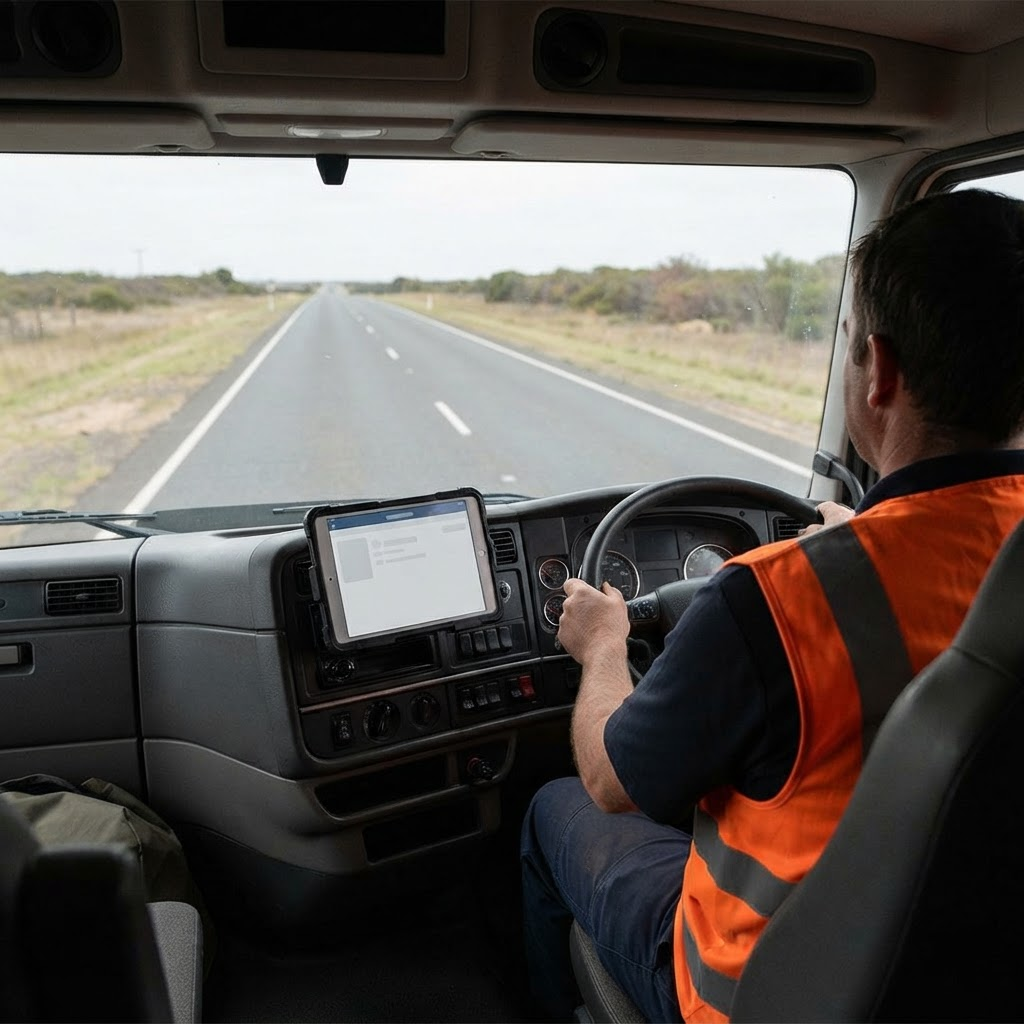
An Electronic Work Diary (EWD) is an electronic device or system approved by the NHVR to monitor and record work and rest times, used by drivers across NSW as an alternative to the written work diary. The obligations are the same as for the paper diary — drivers and operators must be trained on their EWD, records must reach the record keeper, and an authorised officer can check them at an intercept. Drivers do not apply for anything: only technology providers developing an EWD go through the NHVR approval process.
The paper National Driver Work Diary has been the backbone of fatigue compliance for decades. Increasingly, NSW operators are replacing it with an Electronic Work Diary — but an EWD is not just an app. Under the Heavy Vehicle National Law, only systems approved by the NHVR qualify, and the rules around them are specific.
What Is an Electronic Work Diary?
An EWD is an electronic device or system approved by the NHVR to monitor and record work and rest times, and it can be used by drivers as an alternative to making records in a written work diary. The NHVR publishes a register of companies whose EWD systems are approved for use.
The key word is approved. A generic logging app, a spreadsheet or a telematics dashboard is not an EWD unless the system has been approved by the NHVR under the EWD Standards. Approval carries conditions of use, and approval holders, record keepers and drivers must ensure the EWD functions in accordance with the standards and conditions set by the NHVR at all times.
The distinction matters against the broader world of fatigue monitoring technology: cameras and alertness systems are safety tools, but only an NHVR-approved EWD legally replaces the written diary.
Same Obligations as the Written Diary
Drivers, transport operators, record keepers and authorised officers have the same obligations using EWDs as they do for the written work diary. The EWD automates many of the functions, which makes day-to-day operations faster and easier — but the underlying duties do not change:
- Drivers identify and authenticate themselves in the system, and declare their periods of work and rest through the user interface. That information is automatically sent to the record keeper.
- Record keepers still must fulfil their record-keeping obligations with the data the EWD sends.
- Authorised officers can be shown EWD records during an intercept to confirm the driver is complying with work and rest limits. In NSW, intercepts are commonly carried out by authorised officers from the NSW Police Force and Transport for NSW.
The work and rest limits themselves are unchanged by using an EWD — standard hours, BFM or AFM limits apply exactly as they do on paper, as explained in our guide to work and rest hours for heavy vehicle drivers in NSW. If your operation needs more flexibility than the standard limits allow, the path is BFM accreditation or an NHVR fatigue management exemption — not the technology you record your hours with.
Who Needs Training on an EWD?
Drivers and transport operators need appropriate training on the use of their EWD. This is an NHVR requirement, not an optional extra: a driver who cannot correctly declare work and rest periods through the system is not compliant, whatever the technology does in the background.
For most NSW drivers, the natural starting point is fatigue management training — the one-day, NHVR-compliant, face-to-face Drivers Fatigue Management Course (TLIF0005) at Kells Safety Centre (RTO 91528), Wetherill Park. It builds the fatigue-management knowledge the EWD records are designed to evidence, and it is the qualification drivers need to operate under BFM. Record keepers and schedulers have their own one-day schedulers fatigue management course.
How Operators Adopt an EWD
Transport operators adopting EWDs have three options:
- Develop their own EWD — for larger operators with in-house capability.
- Buy an off-the-shelf EWD — the common path for most fleets.
- Buy an EWD integrated with other regulatory systems — for example one linked to the intelligent access program.
If the system meets the performance requirements in the EWD Standards, it can be approved for operation, along with its conditions of approval and use. Technology providers and operators developing an EWD must complete the NHVR application process and are encouraged to engage with the NHVR before lodging an application.
Do Drivers Need to Apply to Use an EWD?
No. Drivers and transport operators do not need to apply to use an EWD that is already approved by the NHVR — they simply adopt an approved system and use it in accordance with its conditions. Only technology providers developing an EWD go through the approval process.
This is why checking the NHVR’s EWD register matters: it lists the companies whose systems are approved. If a provider is not on the register, its product is not an EWD in the legal sense.
The Generation 2.0 EWD Framework
The NHVR, in partnership with Transport Certification Australia (TCA), has developed a new Generation 2.0 EWD framework, including a new EWD System Specification and strengthened testing, assurance and governance arrangements. For drivers and operators there are no immediate changes: existing approved EWD systems remain approved and available, and there is no requirement to replace an existing approved system when the Gen 2.0 specification is released.
Key Takeaways:
- An EWD is an NHVR-approved electronic system for recording work and rest, and a legal alternative to the written work diary.
- Obligations are identical to the paper diary — the technology automates the recording, not the duty.
- Drivers and operators must be trained on their EWD; drivers declare work and rest through the system.
- No application for drivers — only EWD technology providers apply. Check the NHVR EWD register before buying.
- Existing approved EWDs remain valid under the incoming Gen 2.0 framework.
Frequently Asked Questions
What is an electronic work diary (EWD)?
An electronic device or system approved by the NHVR to monitor and record a driver’s work and rest times, usable as an alternative to the written work diary. Only systems approved by the NHVR under the EWD Standards qualify — the NHVR publishes a register of approved EWD providers.
Is an EWD compulsory for NSW truck drivers?
No. An EWD is an alternative to the written National Driver Work Diary. Drivers can continue using the paper diary; those who adopt an EWD must use an NHVR-approved system in accordance with its conditions.
Do drivers need to apply to the NHVR to use an EWD?
No. Drivers and transport operators do not apply to use an EWD that is already approved. Only technology providers developing an EWD must complete the NHVR application process.
Do the work and rest limits change with an EWD?
No. Standard, BFM and AFM work and rest limits apply exactly as they do with a paper diary. The EWD changes how records are kept, not the limits themselves.
What training is required to use an EWD?
Drivers and transport operators must receive appropriate training on the use of their EWD. Drivers identify and authenticate themselves and declare their work and rest periods through the system, with the records sent automatically to the record keeper.
Can a telematics or tracking app replace the work diary?
Not unless the system is an NHVR-approved EWD. A monitoring or tracking product that is not on the NHVR’s EWD register does not legally replace the written work diary.
Who can access the information recorded by an EWD?
The driver (to check the recorded information is correct), the driver’s record keeper (to meet record-keeping obligations), and an authorised officer during an intercept, to confirm the driver is complying with work and rest limits.
What is Generation 2.0 of the EWD framework?
An updated framework developed by the NHVR with Transport Certification Australia, including a new EWD System Specification and strengthened testing and governance. Existing approved EWD systems remain approved — there is no requirement to replace them when Gen 2.0 is released.