In a DG spill in NSW: Stop immediately and secure the scene. Call 000 and the NSW EPA Environment Line (131 555). Don’t attempt to clean up — keep people well back and stay upwind. Consult your Emergency Procedure Guide (EPG) for load-specific procedures. Notify your transport company. If it’s a Division 1.1 load or major fire/health risk, call HAZMAT. Stay on-site for authorities. This is your legal obligation under the ADG Code and EPA Protection of the Environment Operations Act.
Why This Matters First
If you transport dangerous goods in NSW, a spill isn’t “if” — it’s “when.” Your response in the first 5 minutes determines whether it becomes a minor incident, a major environmental breach, or a disaster. NSW EPA and NHVR take DG spills seriously — failure to respond correctly can result in penalties, loss of your DG licence, and civil liability if someone is harmed.
This is also a legal requirement under the ADG Code and the NSW Protection of the Environment Operations Act. You must know what to do.
The First 5 Minutes: Your Response Checklist
1. STOP and SECURE THE SCENE (Do this first)
- Stop your vehicle immediately and turn on hazard lights.
- If you’re on a busy road, position your vehicle to warn other traffic if it’s safe to do so.
- Don’t re-enter the load area or attempt to contain the spill yourself.
- Isolate the area — keep bystanders well back and stay upwind (check your EPG for product-specific guidance).
- If there’s fire, smoke, or strong chemical smell, move much further back — follow your EPG, and for flammable goods keep ignition sources at least 15 metres away.
- Turn off the engine.
Why? An uncontrolled spill can ignite, release toxic fumes, or contaminate soil and water. Your safety and others’ comes first. You cannot fix a spill on the roadside.
2. CALL 000 (Seconds matter here)
- Call triple-zero immediately. Tell them:
- Exact location (street, suburb, postcode, landmark — use Google Maps pin if possible)
- That it’s a dangerous goods spill
- Number of people in the area
- Any visible fire, smoke, or odour
- Stay on the line. Tell them if the load is on fire or if there’s a health risk.
- 000 will dispatch emergency services — the EPA must still be notified separately on 131 555.
3. NOTIFY THE EPA ENVIRONMENT LINE (Do this while 000 is responding)
- Call NSW EPA Environment Line: 131 555 (24/7, free)
- Tell them:
- Your location
- The type of dangerous goods (check your consignment note if you’re safe to access the cab)
- Quantity and UN number if you have it
- What’s been spilled — on road, in soil, into water?
- EPA will decide if a full response team is needed or if it’s a minor incident.
EPA treats spills seriously. If you don’t call, you’re breaching environmental law — and EPA investigators will find out anyway through other reports. Better to report upfront.
4. CONSULT YOUR EMERGENCY INFORMATION PANEL (EPG)
- Your vehicle MUST carry an Emergency Information Panel (physical laminated card or digital) with:
- Load details (UN number, proper shipping name, hazard class)
- Emergency responder guidance specific to that load
- First aid instructions
- Decontamination procedures
- Keep it accessible in your cab.
- If first responders arrive and ask, show it to them immediately.
- If it’s a specialist load (Division 1.1 explosives, highly toxic gases), your EPG will tell you to call HAZMAT or specialist responders.
No EPG? That’s a compliance breach — and if EPA finds out during the cleanup, it adds more penalties.
5. NOTIFY YOUR TRANSPORT COMPANY / DISPATCHER IMMEDIATELY
- Call your transport company’s emergency number (you should know it).
- Tell them:
- Location and time of spill
- That you’ve called 000 and EPA
- Nature of the load
- Estimated quantity spilled
- They need to know so they can notify their insurer, begin their own compliance reporting, and arrange a cleanup contractor.
- Your company is also liable under the ADG Code — they have their own reporting obligations to EPA within 24 hours.
6. STAY ON-SITE AND COOPERATE WITH AUTHORITIES
- Don’t leave the scene until emergency responders give you permission.
- When they arrive (fire, police, EPA officers), give them:
- Your consignment note (essential evidence)
- Your EPG (for load-specific procedures)
- Your driver’s DG licence (prove you’re qualified to carry DG)
- A clear account of what happened
- Don’t minimize or exaggerate — just state facts.
- If there are witnesses, stay to provide contact details.
What NOT to Do
❌ Don’t attempt to clean up the spill yourself — you’re not trained, it’s unsafe, and you’ll breach EPA law.
❌ Don’t move the vehicle unless explicitly told by emergency services.
❌ Don’t discard absorbent materials yourself — they’re contaminated waste now.
❌ Don’t fail to report to EPA — that’s a separate offence.
❌ Don’t blame the load type or say “it’s not that dangerous” — let EPA and emergency services assess.
❌ Don’t delay notifying your employer — they need to report within 24 hours.
After the Emergency: Your Reporting Obligations
Even after 000 and EPA are on-site, you have further obligations:
- Your transport company must report to EPA within 24 hours using the official incident form.
- EPA may issue a penalty notice if the incident caused environmental harm or was caused by non-compliance (e.g., improper packaging, no EPG).
- NHVR may investigate if safety/COR is involved.
- Your DG licence is at risk if EPA finds you negligent or non-compliant.
This is why knowing the first 5 minutes is critical — getting it right protects your licence and your employer’s reputation.
Key Takeaways
✓ Stop, secure, isolate — do this immediately.
✓ Call 000 first, then the EPA Environment Line (131 555).
✓ Stay on-site — don’t leave until responders say so.
✓ Consult your Emergency Procedure Guide (EPG) — it’s legally required.
✓ Notify your employer immediately — they have 24-hour reporting duty.
✓ Provide your consignment note and DG licence to authorities.
✓ Don’t attempt cleanup — that’s a professional job.
✓ Know your EPG procedures — some loads require specialist response.
Frequently Asked Questions
What if it’s a small spill — does it still require reporting?
Yes. NSW EPA defines reportable spills as any environmental harm — soil contamination, water contamination, or air release. A “small spill” that reaches a drain or soil is reportable. Call EPA Pollution Line and let them assess. Failure to report is the offence, not the spill size.
What if I spill a load in a tunnel or on a bridge?
Procedure is the same — stop, call 000, then EPA. But the stakes are higher: tunnels and bridges have containment challenges. Emergency responders may need to close the tunnel/bridge, which will make the incident more complex. Notify your transport company immediately — they’ll need to coordinate with RMS/Transport NSW.
My EPG doesn’t specify procedures for this type of spill — what do I do?
Call 000 and EPA — tell them the load details and ask them to advise. Your EPG is a guide, but emergency responders are trained to handle gaps. Don’t guess or attempt containment on your own.
Can I be fined for a genuine accident?
Possibly. NSW EPA assesses fault — if the spill was caused by reckless driving, improper packaging, inadequate restraint, or failure to comply with the ADG Code, you and your employer can be fined. If it was unavoidable (e.g. another vehicle hit you), liability may rest with the other party. Reporting correctly protects you.
What if I don’t have a DG licence but I’m transporting DG?
This is a bigger problem. You’re breaking the law by driving unlicensed. In a spill, you’ll face both environmental penalties AND a DG licence breach charge. If you’re unsure whether you need one, contact your employer or call Kells Safety Centre to confirm your role.
Does my insurance cover a DG spill?
Insurance typically covers accidental environmental damage, but only if you followed procedures correctly. Failure to report to EPA or leaving the scene may void your cover. Check your policy, but assume insurance won’t cover negligence.
Next Steps: Prevention, Training, and Readiness
Prevention starts with training. A proper Dangerous Goods Licence course (TLILIC0001) covers:
– Load classification and compatibility
– Correct packaging and securing procedures
– Emergency procedures specific to your loads
– Your legal obligations
Enrol in the Dangerous Goods Licence Course at Kells Safety Centre to master the ADG Code and be truly prepared for any emergency. RTO 91528 — 2-day course, face-to-face, both Wetherill Park and Wollongong venues.
For warehouse staff handling DG (not driving), our DG Awareness Course covers emergency response from the receiving end.
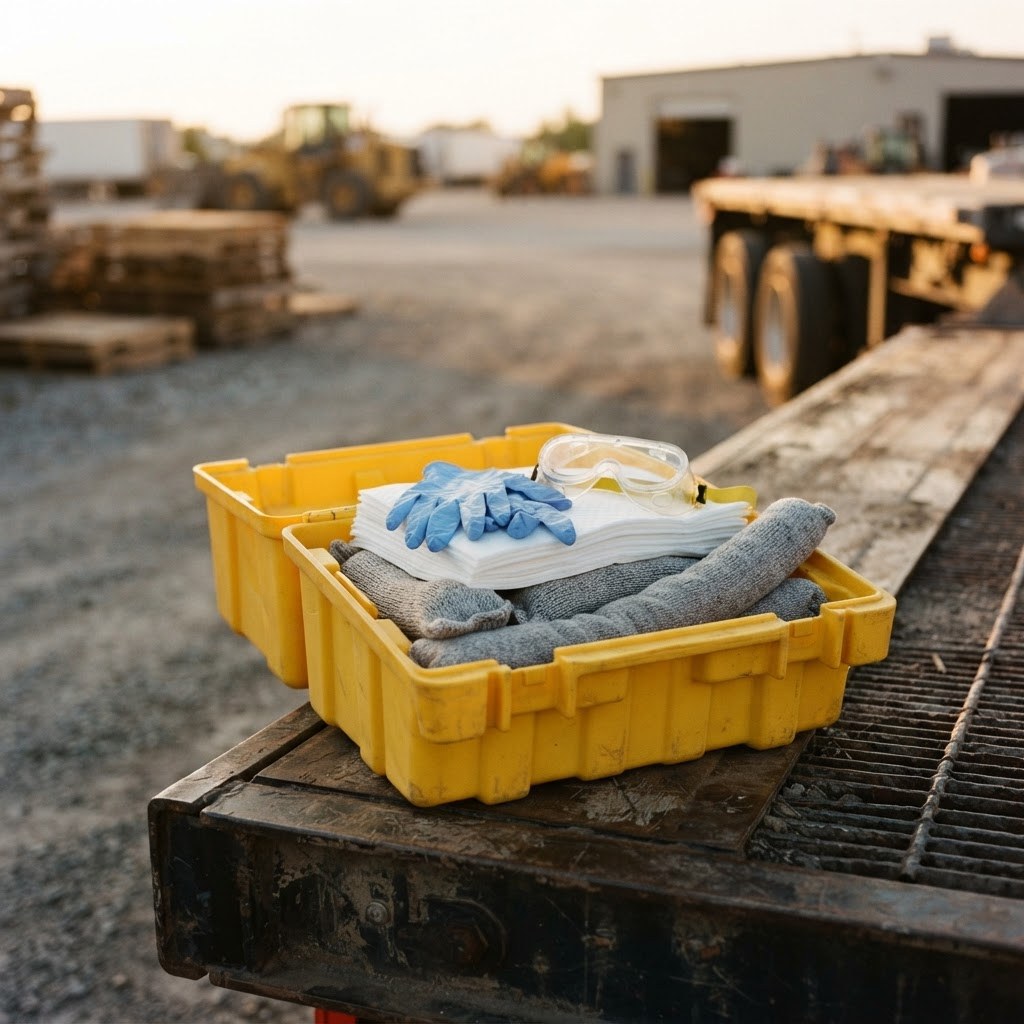
And because you’ll need safety equipment on-site: check out our Safety Equipment range for spill kits, absorbent materials, and emergency signage that meets ADG Code requirements.
Final Word
A spill is traumatic. But knowing exactly what to do in the first 5 minutes turns panic into procedure. Your DG licence proves you understand the risks — now prove you know the response.
Contact Kells Safety Centre if you have questions about emergency procedures, or if your team needs a refresher.
Call 131 555 — EPA Environment Line — anytime you suspect a spill.
Ready to master dangerous goods safety?
Our Dangerous Goods Licence course covers emergency response, load classification, ADG Code compliance, and everything you need to pass TLILIC0001. Face-to-face training at Wetherill Park and Wollongong.
Get Trained in DG Spill Response
Kells Safety Centre (RTO 91528) delivers DG awareness, store and handle, and prepare for transport courses in NSW. View All Training Courses and Book Online