
If you are a plumber, gas fitter, welder, refrigeration mechanic or mobile contractor in NSW, the LPG, oxygen, acetylene and petrol in your ute, van or trailer are dangerous goods — but not the rules written for tankers. Cylinders are packaged dangerous goods, so the NSW dangerous goods driver licence generally does not apply: the licence is a bulk test, a receptacle over 500 litres capacity or over 500 kg. What does apply is cylinder restraint, ventilation, segregation of oxygen from fuel gas, and — above the placard quantity — class placards and a fire extinguisher. Ordinary automotive diesel is not a dangerous good at all.
What You Carry, and What Each Product Triggers
Most tradie vehicles are a mixed load, and each product is classified separately under ADG Code 7.9.
| What you carry | Classification | What it triggers |
|---|---|---|
| Automotive diesel (flashpoint above 60°C) | C1 combustible liquid — not a Class 3 dangerous good | No placards, no DG licence |
| Low-flashpoint diesel (60°C or below) | UN 1202, Class 3, Packing Group III | Counts toward placarding; bulk receptacles over 500 L trigger the driver licence |
| Petrol in cans, tanks, equipment | UN 1203, Class 3, Packing Group I (great danger) | Placard load above 250 kg/L aggregate |
| LPG, propane, butane | Division 2.1 flammable gas | Placard load above 250 kg/L aggregate |
| Acetylene | Division 2.1 flammable gas | Same trigger; never lay a cylinder down |
| Oxygen | Division 2.2, oxidising subsidiary risk | Placard load above 1,000 kg/L; must be segregated from fuel gas |
| Argon, CO2, nitrogen | Division 2.2 non-flammable gas | Placard load above 1,000 kg/L; asphyxiation risk in a closed van |
| Solvent, thinners, paint | Class 3 flammable liquid | Packing group depends on flashpoint — check the SDS |
These classifications follow the flashpoint bands in the Kells Dangerous Goods Training Manual 2026 Edition, which places auto diesel fuel and heating oil in the C1 combustible column, separate from the petrol, naphtha and aviation gas band.
Diesel Is Not a Dangerous Good — Petrol Is
This is the most misunderstood point in a work vehicle. Typical Australian automotive diesel has a flashpoint above 60°C, making it a C1 combustible liquid, not a Class 3 dangerous good: no placards, no dangerous goods driver licence, no emergency information panel for normal diesel haulage.
Only low-flashpoint diesel — flashpoint at 60°C or below — is UN 1202, Class 3, Packing Group III. If the safety data sheet shows 60°C or under, that product is dangerous goods and is treated completely differently from bowser diesel.
Petrol is always Class 3. The Kells manual treats petrol as low-flashpoint Packing Group I (great danger) because its flashpoint sits far below 60°C, so a modest aggregate quantity in cans and equipment tanks can push a vehicle over the placard line — Packing Group I goods placard at 250 kg/L, a quarter of the Packing Group II and III threshold.
Do You Need a Dangerous Goods Licence for Cylinders in a Ute?
Usually not, and the reason matters because the test is often misquoted. The NSW dangerous goods driver licence (TLILIC0001) is a bulk transport requirement: it applies when a vehicle carries dangerous goods in a receptacle with a capacity of more than 500 litres, or containing more than 500 kg. That is a per-receptacle test — which is why tanker drivers need it and tradies generally do not.
Cylinders are packaged dangerous goods. A 45 kg LPG cylinder holds roughly 88 litres of product at LPG’s density, the worked example the Kells manual uses, so it sits far below the bulk line; take the water capacity from the cylinder collar stamp for the exact figure. A stillage of cylinders is packaged DG too.
Two consequences follow. The licence is not the same test as placarding — a packaged load can sit well above the placard quantity and still not need a driver licence. And an IBC exemption exists for up to 3,000 litres in IBCs not filled or emptied on the vehicle, but that is an IBC rule, not a cylinder rule. Our guide to what loads require a dangerous goods licence in NSW sets out the per-receptacle logic in full.
When Your Load Becomes a Placard Load
Under Table 5.3 of the manual, a load is a placard load when the aggregate quantity reaches:
- Any receptacle over 500 L capacity or over 500 kg net mass — always a placard load, any class;
- Division 2.1 or 2.3 gases, or Packing Group I of any class: more than 250 kg/L;
- Division 2.2 gases, aerosols and Packing Group II or III goods: more than 1,000 kg/L.
For Class 2 gases, aggregate quantity is the total capacity in litres of the receptacles, not the weight of gas inside them. That is the detail tradies get wrong: they add kilograms of LPG instead of litres of cylinder capacity. A mixed load is counted as a whole, which is how a welding ute becomes a placard vehicle without anyone noticing — LPG and acetylene both count toward the 250 kg/L line. Above it you need class placards of at least 250 × 250 mm (internal line 12.5 mm from the edge) and, under Table 12.1, one 30B dry powder extinguisher in the cabin plus three AS 3790 warning triangles. No flares.
Placard loads also bring parking and route rules: no parking in a built-up area with public access, within 15 metres of a building where people concentrate, within 8 metres of another placard vehicle, or within 15 metres of a naked flame for Division 2.1 or Class 3 goods. Tunnel restrictions apply to placard loads, which is why crossing the threshold changes your route across Sydney — see our dangerous goods tunnel restrictions guide.
Restraint, Ventilation and Segregation
These obligations apply whether or not you are over the placard quantity, and they are what an inspector looks at first.
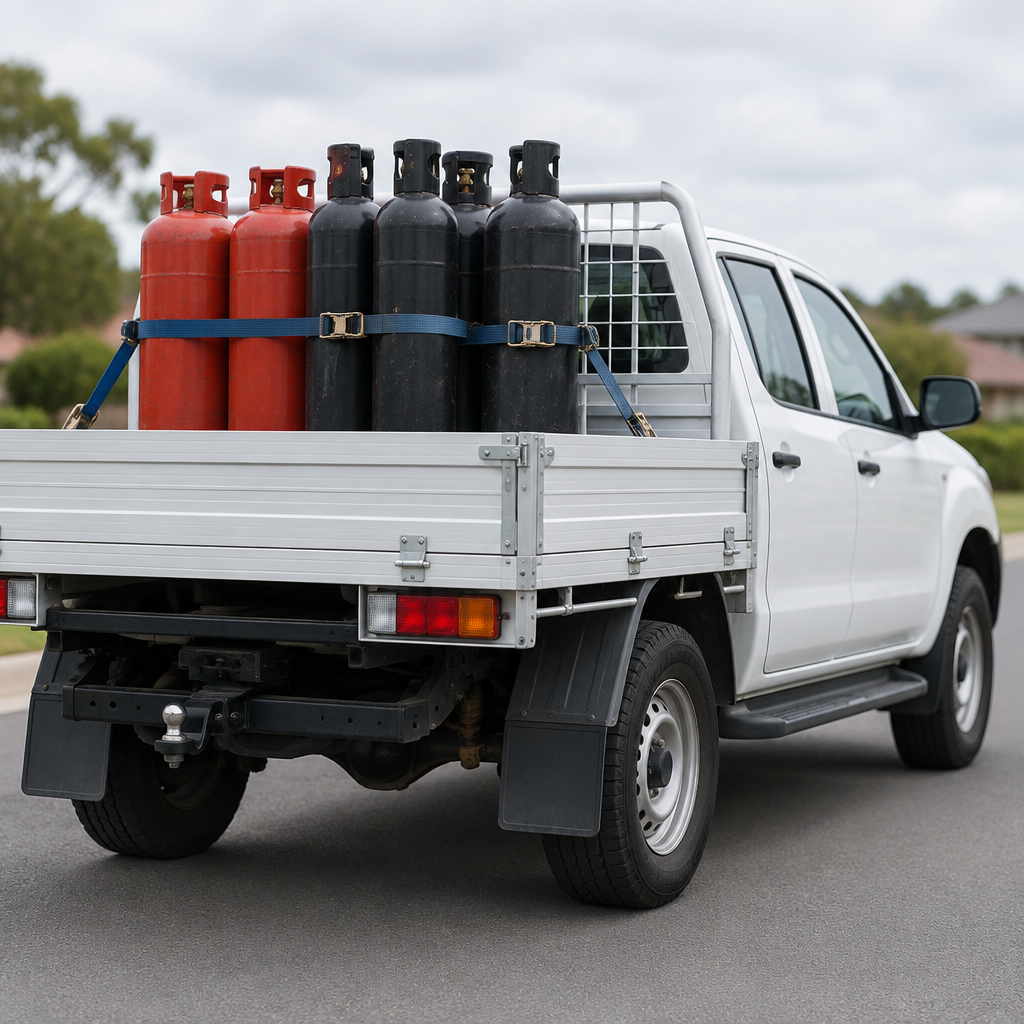
Restraint. Cylinders must be restrained with valves protected. Where Class 2 cylinders travel in gas industry stillages, the manual requires lashing to the Load Restraint Guide with no more than 45% of cylinder height protruding above the stillage rail, and the stillages themselves restrained on the vehicle.
Ventilation. The manual is blunt: Division 2.1 and 2.3 gas cylinders cannot be transported in confined or enclosed transport units, and a placard load must be ventilated to prevent vapour build-up. A sealed van body or hard canopy with LPG, acetylene or oxygen inside concentrates any leak — flammable gas accumulates toward its lower explosive limit, while argon, CO2 or nitrogen displace oxygen in an unvented space.
Segregation. Oxygen makes a fire burn hotter and faster, so oxygen and fuel gas must be segregated under Part 9 of the ADG Code — approved segregation devices, separate cargo units or separate vehicles, not merely shoved into the same tray. Keep grease and oil away from oxygen fittings; contamination is a known ignition pathway.
When a Cylinder Leaks
The manual’s Transport Emergency Plan sequence is worth memorising:
- Shut down the engine, apply the parking brake.
- Get upwind, taking paperwork and safety equipment.
- Call 000 with your location and the UN numbers.
- Notify your employer or principal contractor.
- Notify the NSW EPA Environment Line on 131 555.
- Contain the spill if safe, and set out your warning triangles.
- Keep ignition sources at least 15 metres from any escape of flammable goods.
Fire and Rescue NSW or police take control on arrival. The Emergency Procedure Guide is the guide; the EIP is the panel. Never approach a leaking acetylene cylinder — it can heat, rupture and project.
Training That Fits Around a Tradie’s Week
The gap in most tradie businesses is not diligence, it is framework. People know LPG is flammable; they do not know aggregate quantity is counted in litres of cylinder capacity, or that argon in a sealed van is an asphyxiation hazard. That is exactly what the Dangerous Goods Awareness course covers: $196, self-paced, online, enrol and start 24/7, with a virtual seminar option for groups. It satisfies the training obligation in clause 20 of the Dangerous Goods (Road and Rail Transport) Regulation 2022 (NSW) and explicitly does not authorise bulk transport — which is the point at this level.
If you store and handle gas and chemicals at a depot as well as carry it, Store and Handle (TLID0021) is $294 online. If the business scales into bulk — a tanker or bulk LPG vehicle, anything with a receptacle over 500 litres — the DG Licence (TLILIC0001) is $618, runs two days, and is delivered face-to-face at Wetherill Park and Wollongong.
- Diesel is not a dangerous good. Above 60°C flashpoint it is a C1 combustible liquid: no placards, no DG licence. Only diesel at 60°C or below is UN 1202, Class 3, Packing Group III.
- Petrol is Class 3, UN 1203, Packing Group I, so it placards at 250 kg/L aggregate.
- The driver licence is a bulk rule, not a placard rule: a receptacle over 500 litres or over 500 kg. Cylinders in a ute are packaged DG, so it generally does not apply.
- Placarding still bites. Division 2.1 and 2.3 gases placard above 250 kg/L of total cylinder capacity in litres; Division 2.2 above 1,000 kg/L.
- Restraint, ventilation and segregation are unconditional. No Division 2.1 or 2.3 cylinders in an enclosed transport unit; oxygen kept apart from fuel gas.
- A placard load needs one 30B extinguisher in the cabin and three AS 3790 triangles. No flares.
- Emergency: 000, employer, NSW EPA 131 555, stay upwind, ignition sources at least 15 metres back.
Frequently Asked Questions
Do I need a dangerous goods licence to carry LPG cylinders in my ute in NSW?
Generally no. The NSW dangerous goods driver licence (TLILIC0001) applies to bulk transport — a receptacle with a capacity over 500 litres, or containing over 500 kg. Trade cylinders sit well below that: a 45 kg LPG cylinder holds roughly 88 litres of product. Cylinders in a ute are packaged dangerous goods, so the licence test is not met, but restraint, ventilation, segregation and placarding still apply.
Is diesel a dangerous good in Australia?
No, not in its normal automotive form. Typical Australian automotive diesel has a flashpoint above 60°C, classifying it as a C1 combustible liquid rather than a Class 3 dangerous good, so normal diesel haulage needs no placards and no DG licence. Low-flashpoint diesel at 60°C or below is UN 1202, Class 3, Packing Group III and is regulated. Check the flashpoint on the SDS for the product you actually carry.
At what quantity do LPG cylinders make my vehicle a placard load?
For Division 2.1 gases such as LPG, propane, butane and acetylene the trigger is an aggregate quantity of more than 250 kg/L, and for Class 2 the aggregate is the total capacity in litres of the receptacles — add up cylinder water capacities, not kilograms of gas. Division 2.2 gases such as argon, CO2 and nitrogen placard above 1,000 kg/L, and any receptacle over 500 litres is always a placard load.
Can I carry LPG or oxy cylinders in a closed van or canopy?
No. The Kells Dangerous Goods Training Manual 2026 Edition states that Division 2.1 and 2.3 gas cylinders cannot be transported in confined or enclosed transport units, and requires ventilation for Division 2.1 or 2.3 goods and liquefied oxygen in a placard load. A sealed body concentrates any leak: flammable gas builds toward its explosive limit while argon, CO2 or nitrogen displace oxygen.
Do oxygen and LPG cylinders need to be separated in a work vehicle?
Yes. Oxygen is Division 2.2 with an oxidising subsidiary risk and intensifies any fire, while LPG and acetylene are Division 2.1 flammable gases. Incompatible dangerous goods must be segregated under Part 9 of the ADG Code using approved segregation devices, separate cargo units or separate vehicles. Keep oxygen fittings clear of grease and oil, a known ignition pathway.
What safety equipment must a tradie vehicle carrying a placard load carry?
Under Table 12.1, dangerous goods packed in packages — which is what cylinders and drums in a ute or trailer are — require at least one 30B dry powder extinguisher located in the cabin. You also need at least three portable warning devices complying with AS 3790 in clean condition, plus the personal protective equipment in Table 12.2 for the class carried. Never use road flares; they are an ignition source.
Who do I call if a gas cylinder starts leaking on a job?
Call 000 first with your location and the UN numbers, then notify your employer or principal contractor, then the NSW EPA Environment Line on 131 555. Move upwind, take the paperwork and safety equipment, and keep ignition sources at least 15 metres from the escape while stopping vehicles and people entering that zone. Set out warning triangles if safe. Fire and Rescue NSW take control on arrival.