
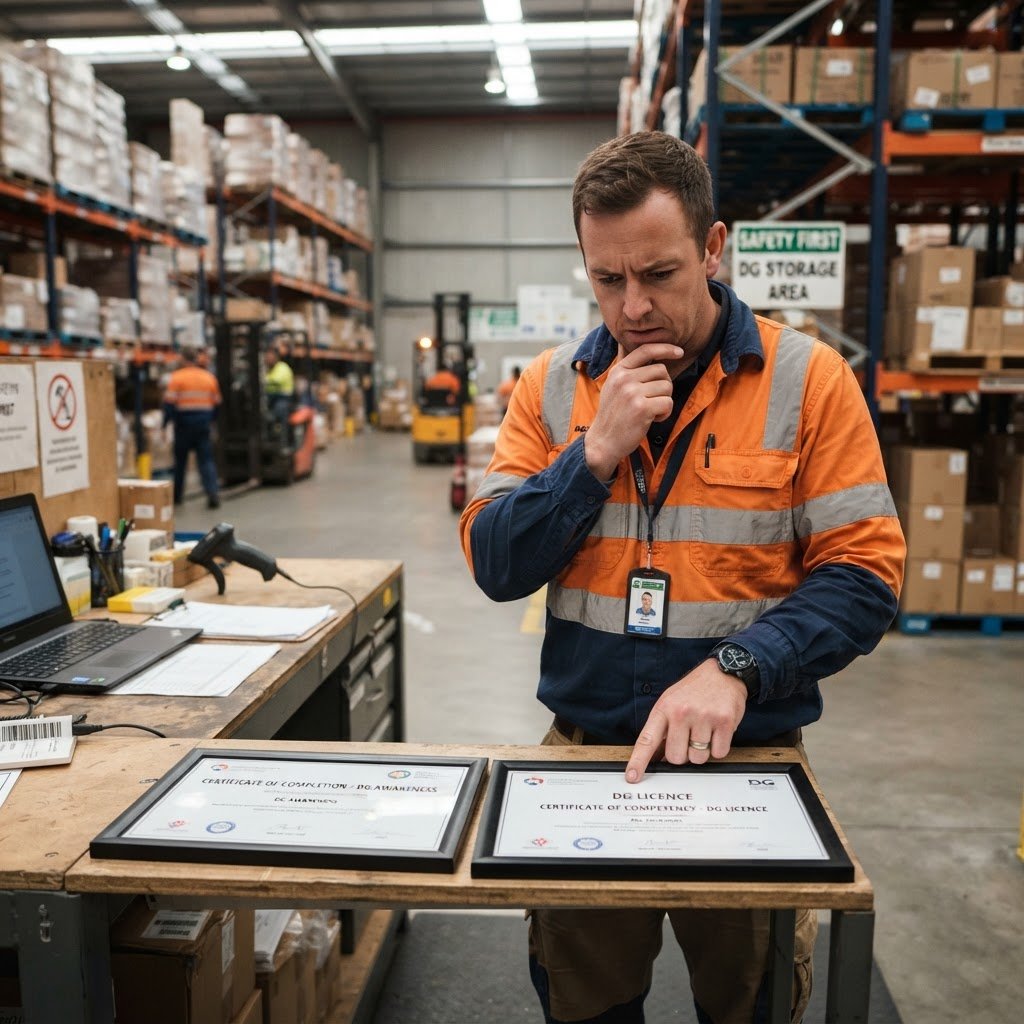
One of the most common questions we hear at Kells Safety Centre is: “Do I need the DG Licence course or just DG Awareness training?” It’s a fair question — and the answer depends entirely on your job.
The difference is crucial. Choose the wrong one, and you risk:
- Not being qualified to do your job legally
- Your employer facing prosecution under Chain of Responsibility (COR)
- Regulatory action if an NHVR or EPA inspector checks your qualifications
- Wasting time and money on the wrong training
The rule is simple: if you drive a vehicle carrying a placard load of dangerous goods, you need a DG Licence. If you handle, store, or work near dangerous goods without transporting them, DG Awareness is what you need. But there are grey areas — and this guide walks you through them.
- DG Licence (TLILIC0001): For drivers transporting placard loads of dangerous goods
- DG Awareness: For warehouse staff, forklift operators, loaders, and non-driving handlers
- Grey area: Van drivers and couriers — depends on what they’re carrying and how often
- Employer responsibility: Your employer must ensure you’re trained for your role — they face COR liability if they don’t
- Confusion costs money: Choosing wrong means re-training, downtime, and potential compliance gaps
The Key Difference: DG Awareness vs DG Licence
The difference boils down to this: driving vs non-driving.
DG Licence (TLILIC0001) is an accredited unit of competency issued by Kells Safety Centre (RTO 91528). It leads directly to a NSW EPA Dangerous Goods Driver Licence. You need it if you operate a vehicle — a truck, tanker, van, car — that carries a placard load of dangerous goods.
A placard load is any quantity of dangerous goods that meets or exceeds the threshold in the ADG Code for that substance class. Think: fuel tankers, chemical tankers, gas cylinder vehicles, or any truck carrying Class 1 explosives, Class 2 gases, Class 3 flammable liquids, corrosives, or other hazardous substances at notifiable quantities.
DG Awareness is a non-accredited awareness program designed for workers who handle, store, load, or unload dangerous goods — but don’t transport them. It covers DG classification, labelling, storage rules, segregation requirements, and emergency response basics. It does NOT lead to a DG driver licence and is NOT required by EPA regulation — it’s required by Safe Work NSW under workplace safety law.
Key point: You cannot use DG Awareness training to satisfy the requirement for a DG Licence, and you don’t need a DG Licence just to work in a warehouse or handle goods. They serve different purposes.
Not sure which you need? Use the decision matrix below, or contact Kells Safety Centre — we’ll point you to the right course.
Decision Matrix: What Course Does Your Job Require?
Use this matrix to find your job title and confirm which course applies:
| Job Title / Role | Typical Task | Course Required |
|---|---|---|
| Warehouse Manager | Oversees storage of dangerous goods | DG Awareness |
| Forklift Operator | Moves pallets of chemicals, gases in warehouse | DG Awareness |
| Chemical Loader | Loads tankers or drums at depot | DG Awareness (maybe DG Licence if they also drive) |
| Van Driver / Courier | Delivers parcels or samples (occasional DG items) | Grey area — see below |
| Rigid Truck Driver (4–8 tonne) | Transports placard loads of chemicals, fuel | DG Licence (TLILIC0001) |
| Tanker Driver | Transports fuel, chemicals in bulk | DG Licence + specialist training |
| B-Double / Articulated Driver | Long-haul transporting placard loads | DG Licence + HVNL fatigue |
| Shift Supervisor (warehouse) | Oversees compliance, emergency response | DG Awareness |
Warehouse and Storage Staff — DG Awareness
If your job is warehouse-based — moving, storing, or handling dangerous goods but NOT driving them — you need DG Awareness training.
This includes:
- Warehouse managers and supervisors
- Forklift operators
- Loaders and unloaders
- Chemical handlers at manufacturing or storage facilities
- Employees working in facilities storing Class 3 flammables, Class 2 gases, Class 5/6 oxidizers, corrosives, or other hazardous goods
DG Awareness covers classification, labelling, hazard symbols, segregation rules, safe handling practices, personal protective equipment (PPE), and emergency procedures. You don’t get a formal licence, but your training is recorded and demonstrates compliance with Safe Work NSW requirements.
DG Awareness can be completed online through Kells Safety Centre — no face-to-face requirement — making it flexible for shift workers.
Van Drivers and Couriers — Grey Area (Usually Awareness)
Van drivers and courier services are in a grey area. Here’s why:
If you drive a van and deliver parcels that occasionally contain dangerous goods items (like batteries, nail polish remover, aerosols, or laboratory chemicals) in sub-placard quantities, you technically don’t need a DG Licence — you need awareness only.
But if:
- You regularly transport placard quantities of dangerous goods, OR
- Your employer requires it for insurance or safety reasons, OR
- Your client (e.g. a mining operation or transport broker) specifies it as a condition of work,
Then you should have a DG Licence.
The safest approach: ask your employer or check your job contract. If there’s any doubt, the DG Licence is the gold-standard qualification and opens more doors.
Rigid Truck Drivers — DG Licence Required
If you drive a rigid truck (4–8 tonne) and transport placard loads of dangerous goods, you need a DG Licence (TLILIC0001).
This covers:
- Drivers of vehicles up to 12 tonne GVM carrying placard loads
- Tanker drivers (fuel, chemicals, liquid waste)
- Drivers of vehicles carrying compressed gas cylinders at notifiable quantities
- Drivers transporting explosives, flammable liquids, oxidizers, or corrosives
The DG Licence is issued by the NSW EPA after you complete TLILIC0001 training with a registered RTO like Kells. It’s a legal requirement under the Dangerous Goods (Road and Rail Transport) Act 2008 — you cannot drive a vehicle carrying a placard load without it.
Kells delivers TLILIC0001 face-to-face at Wetherill Park and Wollongong. The course takes 1–2 days and covers DG classification, ADG Code rules, documentation, placarding, emergency procedures, and practical assessment.
B-Double and Articulated Drivers — DG Licence Required
Long-haul B-double and articulated drivers transporting placard loads definitely need a DG Licence. They also need to comply with fatigue management under the Heavy Vehicle National Law (HVNL).
In addition to the DG Licence, most B-double operations require:
- Basic Fatigue Management (BFM) — TLIIF0005 for drivers
- Chain of Responsibility (COR) awareness — understanding your legal obligations
- Advanced DG knowledge for specific dangerous goods classes (e.g. explosives or Class 1 goods require additional endorsements)
Kells offers a combination package for fleet operators: DG Licence + BFM + COR awareness. Contact us for group training rates.
Employer Liability: What Happens If You Get It Wrong
Here’s the legal reality: your employer is liable under Chain of Responsibility (COR) if they send a worker to do a job without the correct training.
If an NHVR inspector roadside-checks your credentials and finds you don’t hold the right qualification, the driver faces an on-the-spot fine, but the employer faces prosecution. For serious COR breaches, penalties reach $500,000+ for corporations and criminal liability for senior executives.
From an employer’s perspective: if there’s any doubt, train your people to the higher standard. It’s cheaper to fund a DG Licence than to fight a COR prosecution.
From a worker’s perspective: if your employer tells you to do a course that doesn’t match your job, ask questions. Safe Work NSW and the EPA have dispute resolution channels, and your employer cannot retaliate for raising a legitimate safety concern.
How to Know Which Course to Book
Three steps to confirm which course you need:
1. Check your job description and duty statement. Does it mention transporting dangerous goods by vehicle? If yes — DG Licence. If you handle goods in a warehouse or facility — DG Awareness.
2. Ask your employer or manager. They should be able to tell you. If they’re unsure, that’s a red flag — they may not have done a proper safety audit.
3. Contact Kells Safety Centre. If you’re still unsure, send us your job description and we’ll advise. It’s free and takes 5 minutes.
Once confirmed, you can view all our training courses and enrol.
Key Takeaways
- DG Licence (TLILIC0001): for drivers of vehicles carrying placard loads
- DG Awareness: for warehouse staff, loaders, and handlers (non-drivers)
- The rule: if you drive a vehicle carrying dangerous goods, you need a DG Licence
- Grey areas: van drivers and couriers — check with your employer or insurance
- Employer liability: your employer is liable under COR if they don’t ensure correct training
- Both courses available at Kells: DG Licence face-to-face (1–2 days), DG Awareness online (flexible)
- Wrong course = compliance risk: wasted time, money, and potential regulatory action
Frequently Asked Questions
What’s the difference between DG Awareness and a DG Licence?
DG Licence (TLILIC0001) is an accredited qualification for drivers of vehicles carrying placard loads of dangerous goods. DG Awareness is non-accredited training for workers who handle dangerous goods in warehouses or facilities but don’t drive them. They serve different purposes and are not interchangeable.
Do I need a DG Licence if I drive a van?
It depends. If you occasionally deliver parcels with sub-placard quantities of dangerous goods (like batteries or aerosols), DG Awareness is usually sufficient. If you regularly carry placard-load quantities or your employer requires it, then a DG Licence is needed. Check your job contract or ask your employer.
Can I use DG Awareness training instead of a DG Licence?
No. DG Awareness does not satisfy EPA requirements for drivers. If your job requires driving a vehicle carrying placard loads, only a DG Licence issued by an RTO will meet the legal requirement. Using DG Awareness as a substitute exposes your employer to COR liability.
What if my employer tells me to do the wrong course?
Raise the concern with your manager or HR. If they’re unclear on what’s required, suggest they contact Kells Safety Centre — we can clarify what your role actually needs. You have the right to speak up about safety matters without retaliation.
How do I know if my job handles a placard load?
A placard load is any quantity of dangerous goods that meets or exceeds the threshold in the ADG Code for that substance class. Check with your employer or look at the goods you handle — if they have a hazard label and you transport them by vehicle, it’s likely a placard load. Kells can help you determine this.
Can I do DG Awareness training online?
Yes. Kells Safety Centre offers DG Awareness online with flexible learning and assessment. The TLILIC0001 DG Licence, however, requires face-to-face practical assessment — it cannot be done fully online.
Does DG Awareness training lead to a DG Licence?
No. DG Awareness is a separate, non-accredited program. It does not lead to or count toward a DG driver licence. If you later need a DG Licence, you must complete the full TLILIC0001 course separately.
What happens if I transport dangerous goods without the right qualification?
You can face on-the-spot fines from NHVR, and your employer faces prosecution under Chain of Responsibility. Penalties for serious non-compliance can exceed $500,000 for corporations and include criminal liability for executives. It’s not worth the risk.
Ready to Get the Right Training?
Confused about which course you need? Kells Safety Centre (RTO 91528) offers both DG Licence (TLILIC0001) and DG Awareness training. Check which course is right for your job.