

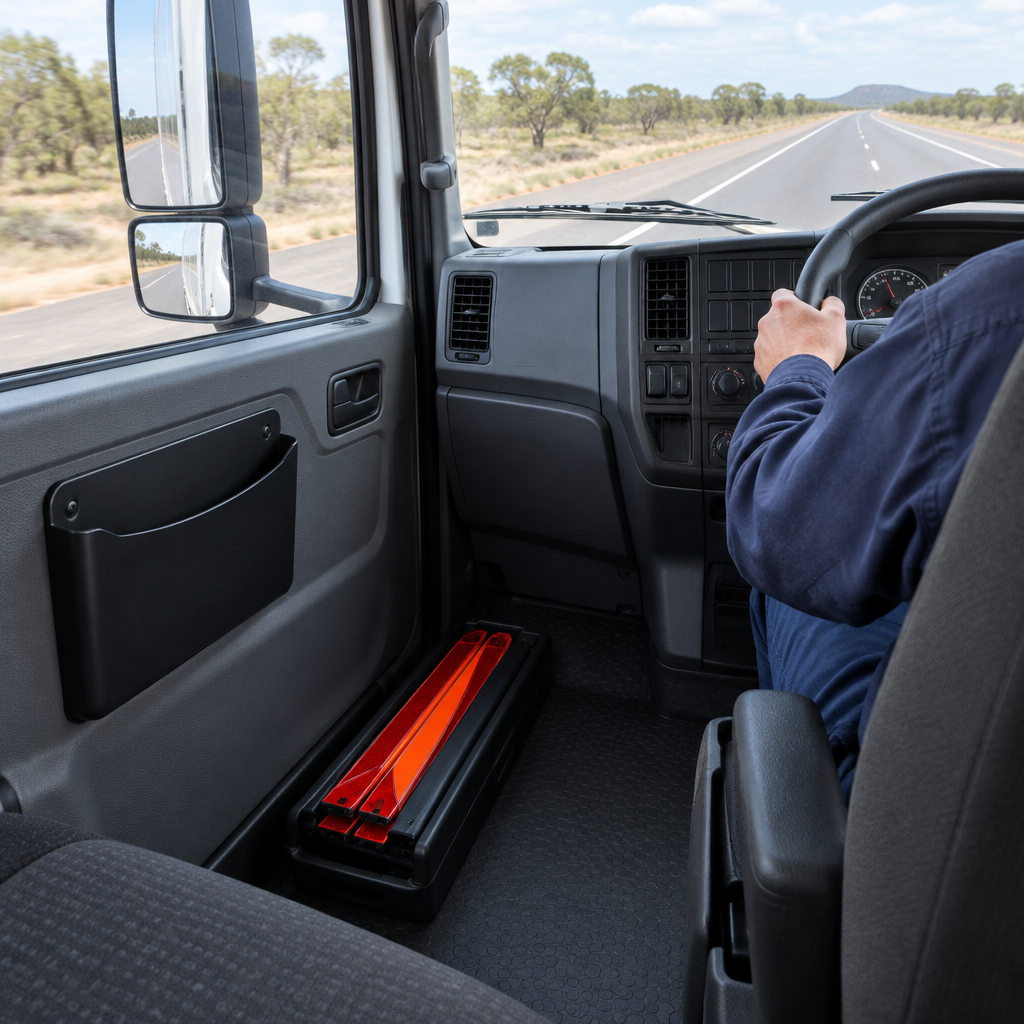
If your vehicle carries a dangerous goods placard load in NSW, three things must be right before it moves: an Emergency Procedure Guide (EPG) holder in the cabin containing the emergency information and transport documentation, at least three portable warning devices complying with AS 3790, and fire extinguishers rated for the load.
The EPG is the written guide kept in the cabin. The Emergency Information Panel (EIP) is the external panel fitted only to bulk vehicles. Two different items, two different places, not interchangeable.
A DG cabin kit in NSW has three parts. The EPG holder — a marked holder fixed inside or immediately beside a cabin door, holding the product-specific emergency procedure guides, the vehicle-fire guide and the transport documentation. At least three warning triangles complying with AS 3790 — never two, never road flares. And fire extinguishers: for a flammable bulk load, 2 x 60B in the load area plus 1 x 10B in the cabin, or 1 x 80B plus 1 x 20B foam in the load area plus 1 x 10B in the cabin. Packaged-only placard loads display class placards and no EIP.
The Cabin Kit Is a Set of Separate Obligations
There is no single “DG cabin kit” product in the Australian Dangerous Goods Code (ADG Code, edition 7.9) — there is a bundle of duties attached to one trigger: a road vehicle carrying a placard load. When that trigger is met the vehicle needs fire extinguishers, at least three AS 3790 warning devices and the Table 12.2 personal protective and safety equipment, and the driver must be able to produce transport documentation and emergency information, both kept in the EPG holder.
Placard quantity is an aggregate test that varies by class and packing group — not the 500 L / 500 kg per-receptacle test that triggers a DG driver licence, which the NSW EPA administers. See our guide to placardable quantities in NSW; the ADG Code explained is the primary text.
EPG vs EIP: The Guide in the Cabin and the Panel on the Truck
The EPG (Emergency Procedure Guide) is a written, product-specific guide covering what to do in an emergency involving those goods. It lives in the cabin holder where the driver can grab it. Under Chapter 11.2, emergency information means either the Dangerous Goods — Initial Emergency Response Guide, or an EPG for the goods carried plus an EPG covering vehicle fire.
The EIP (Emergency Information Panel) is an external panel on the vehicle, required for *bulk* transport — tanks, bulk containers and receptacles over 500 L or 500 kg — and not for a packaged-only placard load. A standard EIP is 800 x 600 mm, with at least 400 x 300 mm permitted for IBCs up to 3 m³. The lower edge sits at least 450 mm above ground, on the rear and sides of the vehicle.
A packaged-only placard load instead displays class placards of at least 250 x 250 mm with the internal line 12.5 mm from the edge — and displays no EIP at all. Fitting one to a packaged load is a marking error, not extra caution. Compare formats in our guide to EIP panel types.
The EPG Holder: Marking and Placement
The Code describes the holder as sized to carry emergency information and dangerous goods transport documentation, marked “Emergency Procedure Guides” or “Emergency Information” in 10 mm high lettering on a white background. If an inspector cannot identify it from the driver’s seat, it does not meet that description.
Placement is prescribed: on the inside of a cabin door, or immediately adjacent to a cabin door. Only where the vehicle’s construction prevents that may it go elsewhere in the cabin in a prominent location — and then a notice identifying its position must be affixed to the inside of the driver’s door, with the holder still visible and accessible.
The Documents That Travel Inside It
Two sets travel together: the emergency information (product EPG plus vehicle-fire EPG) and the transport documentation.
Under Chapter 11.1, the transport document must show the consignor’s name and phone number, then in order: UN number, proper shipping name, class or division, subsidiary hazards, packing group, a description of each package or receptacle type, the number of each type, and the aggregate quantity. Dangerous goods must be listed before any non-dangerous goods on the same document.
Three traps. Empty but uncleaned tanks, bulk containers, portable tanks and IBCs with residue still need paperwork marked “EMPTY – UNCLEANED”. On a combination carrying a placard load, the documentation must show which goods are in which unit. Deliver part of the load and the paperwork must be updated to what remains.
Three Triangles Minimum — and Never a Flare
A placard vehicle must carry at least three portable warning devices complying with AS 3790, clean and in good condition. Not two — three is the floor because the placement rules can consume all three at once. At 80 km/h or more: one triangle 200–250 m behind the vehicle; a second between it and the vehicle on a one-way or divided road, or 200–250 m in front of the vehicle or fallen load on any other road; and one at the traffic side. Under 80 km/h the same pattern uses 50–150 m.
Never use road flares. A flare is an ignition source, and a load of Division 2.1, Class 3, Class 4 or Class 5 goods is precisely where a flame near a vapour cloud is catastrophic. For the same reason, matches, lighters and other ignition sources must not be carried in the cabin or load space when those goods travel in bulk receptacles.
Extinguisher Logic: One in the Cabin, the Right Ones Behind It
The cabin unit is where drivers go wrong, because its rating depends on the load. Under Table 12.1, a flammable bulk load — bulk Division 2.1, Class 3 or Class 4 goods, or goods with a subsidiary hazard of 2.1, 3 or 4 — needs either 2 x 60B dry powder in the load area plus 1 x 10B in the cabin, or 1 x 80B plus 1 x 20B foam in the load area plus 1 x 10B in the cabin.
The foam unit belongs only to the 80B alternative. It is not an add-on to the two-60B option and not a substitute for the cabin unit. Non-flammable bulk loads take 1 x 60B or 2 x 30B in the load area with 1 x 10B in the cabin; packaged goods, drums, overpacks and non-flammable IBCs take 1 x 30B in the cabin or at the front of the trailer.
Do not convert kilograms to B ratings. The B rating is a fire-test classification stamped on the nameplate, and two extinguishers of the same weight can carry different ratings. Read the nameplate before you buy or sign a pre-start. Units need quick-release mounting, ready access, and servicing at least every six months per AS 1851, with a gauge and tag check before each trip.
The Cabin and Vehicle Kit Checklist
Each row is a separate requirement with its own trigger. A tick in one row never covers another.
| Item | The rule | Where it goes |
|---|---|---|
| EPG holder | Marked “Emergency Procedure Guides” or “Emergency Information”, 10 mm lettering on white | Inside or beside a cabin door; driver’s-door notice if elsewhere |
| Emergency information | Product EPG plus vehicle-fire EPG (or the Initial Emergency Response Guide) | Inside the holder |
| Transport documentation | Consignor name and phone; UN number; proper shipping name; class; subsidiary hazards; packing group; package types; quantities; aggregate quantity | Inside the holder, with the EPGs |
| Warning triangles | Minimum three, complying with AS 3790, clean and in good condition — never flares | Secure, accessible stowage |
| Cabin extinguisher | 1 x 10B for bulk loads (1 x 30B for packaged loads); quick-release mounted | Cabin, or directly behind or on the cabin rear |
| Load-area extinguishers | Flammable bulk: 2 x 60B, or 1 x 80B plus 1 x 20B foam. Non-flammable bulk: 1 x 60B or 2 x 30B | Load area; each placarded trailer on combinations |
| PPE and safety equipment | Table 12.2 items for the class carried, clean and ready; respiratory escape protection in the cabin where required | Securely stowed, readily accessible |
| EIP panels (bulk only) | 800 x 600 mm (at least 400 x 300 mm for IBCs up to 3 m³), lower edge at least 450 mm above ground | Rear and sides of vehicle |
| Class placards (packaged) | At least 250 x 250 mm, internal line 12.5 mm from the edge — no EIP | Front and rear; sides as required on combinations |
Equipment that is missing, expired or inaccessible is treated as no equipment at all — the principle behind Safe Work NSW guidance on keeping plant in sound condition. Our DG emergency equipment checklist goes deeper.
Using the Kit in the Right Order
Shut down the engine and apply the parking brakes. Gather the paperwork and safety equipment and get upwind. Assess the situation, including whether to evacuate. Call 000 with your location and the UN number or numbers; notify your employer; notify the state authority — in NSW the EPA Environment Line on 131 555. Contain the spill only if it is safe, then set out the triangles.
Two numbers to hold: stay upwind, and keep other vehicles, other dangerous goods and any ignition source at least 15 m from your vehicle if flammable goods have escaped. The EPG in the holder gives the product-specific steps; the EIP on the truck tells an arriving crew what they are dealing with. That division of labour is why both exist.
- EPG is the guide, EIP is the panel. The EPG is written, product-specific and kept in the cabin holder; the EIP is an external 800 x 600 mm panel for bulk vehicles only.
- Packaged placard loads carry no EIP — they display class placards of at least 250 x 250 mm with a 12.5 mm internal line.
- The holder must be identifiable and accessible, marked in 10 mm lettering and mounted inside or beside a cabin door.
- Two document sets travel together: the emergency information and the transport documentation.
- Three triangles, not two — AS 3790 compliant, and never road flares.
- Flammable bulk: 2 x 60B plus a cabin 10B, or 1 x 80B plus 1 x 20B foam plus a cabin 10B. Foam belongs only to the 80B option.
- Check the nameplate, not the weight — kilograms do not convert to a B rating.
Frequently Asked Questions
What is an EPG holder and what goes inside it?
An EPG holder is a marked holder sized to carry emergency information and dangerous goods transport documentation, fixed in a prominent, accessible cabin position. Inside it you keep the emergency information — the Emergency Procedure Guide for the goods on board plus an EPG covering vehicle fire, or the Initial Emergency Response Guide — together with the transport documentation: the consignment note showing UN numbers, proper shipping names, classes, packing groups and quantities.
What is the difference between an EPG and an EIP?
The EPG (Emergency Procedure Guide) is a written, product-specific guide covering procedures in an emergency involving the goods; it is kept in the cabin holder. The EIP (Emergency Information Panel) is a physical panel on the outside of the vehicle showing the UN number, proper shipping name, HAZCHEM code, class labels and emergency contact details. The EPG is the guide; the EIP is the panel. A packaged placard load needs cabin emergency information but displays no EIP.
How many portable warning devices must a dangerous goods vehicle carry in NSW?
A minimum of three. The ADG Code requires at least three portable warning devices complying with AS 3790, clean and in good condition — the minimum because placement rules can require all three at once: one behind, one in front or between on a divided road, one at the traffic side. Road flares must never be used: they are an ignition source and exactly the wrong tool near a flammable load.
What fire extinguishers does a flammable bulk load require?
Table 12.1 gives two acceptable arrangements: 2 x 60B dry powder in the load area plus 1 x 10B in the cabin, or 1 x 80B dry powder plus a 1 x 20B foam unit in the load area plus 1 x 10B in the cabin. The foam unit forms part of the 80B alternative only. Non-flammable bulk loads take 1 x 60B or 2 x 30B in the load area, still with 1 x 10B in the cabin.
Do packaged dangerous goods loads need an EPG holder?
Yes, if the load is a placard load. Emergency information and transport documentation must be kept together in the EPG holder whenever dangerous goods are carried as a consignment, and a placard load must also carry the required safety equipment. What a packaged-only placard load does not need is an EIP — it displays class placards of at least 250 x 250 mm on the front and rear.
Can the EPG holder be kept in the glovebox or a drawer?
Not as a substitute for the prescribed positions. It must be securely placed inside a cabin door or immediately adjacent to one. Only where the vehicle’s construction makes that impossible may it sit elsewhere in a prominent cabin location, with a notice identifying its position affixed to the inside of the driver’s door — and it must still be visible and accessible. A holder buried under paperwork fails that test.
Where can I buy an EPG holder, warning triangles and DG extinguishers?
Kells Safety Centre supplies EPG holders, AS 3790 warning triangles, fire extinguishers and mounting hardware through the safety equipment shop. Check the shop or contact Kells on 1300 88 75 76 for current pricing, availability and specifications, and confirm the B rating on the extinguisher nameplate against the load you carry. Kells is an ASQA-accredited RTO (91528) and delivers the DG licence course covering these requirements in the classroom.