
Placardable quantities — the point at which dangerous goods transport triggers mandatory placarding, PPE and documentation requirements — are one of the most important thresholds in the ADG Code. Yet they’re also one of the most commonly misunderstood.
This guide explains what placardable quantities are, how they’re calculated, and what they mean for drivers, consignors, and businesses transporting dangerous goods in NSW.
What Are Placardable Quantities?
Under the Australian Dangerous Goods Code (ADG Code), a placardable quantity is the minimum amount of a dangerous good that, when present on a vehicle, triggers a mandatory set of compliance requirements — specifically:
- Fitting of DG placards to the vehicle
- Displaying an Emergency Information Panel (EIP) (only for ‘bulk’ loads)
- Carrying a compliant dangerous goods documentation
- Carrying certain PPE, fire extinguishers and other safety equipment
In simple terms: if your load meets or exceeds the placardable quantity for its class, the full suite of DG transport requirements applies to that vehicle and driver.
How Are Placardable Quantities Set?
Placardable quantities are set in the ADG Code — specifically in the Dangerous Goods List (DGL) and in the placarding tables. They vary by:
- Hazard class — different classes of dangerous goods have different thresholds
- Packing group — higher hazard packing groups (PG I) generally have lower thresholds than lower hazard groups (PG III)
- Packaging type — bulk loads (tanks, IBCs) are assessed differently to packages
The key principle is that more hazardous substances are subject to stricter controls at smaller quantities. A small load of a highly toxic substance may trigger placarding obligations at a much lower quantity than a large load of a lower-risk substance.
Common Examples of Placardable Quantities
To illustrate how thresholds work in practice:
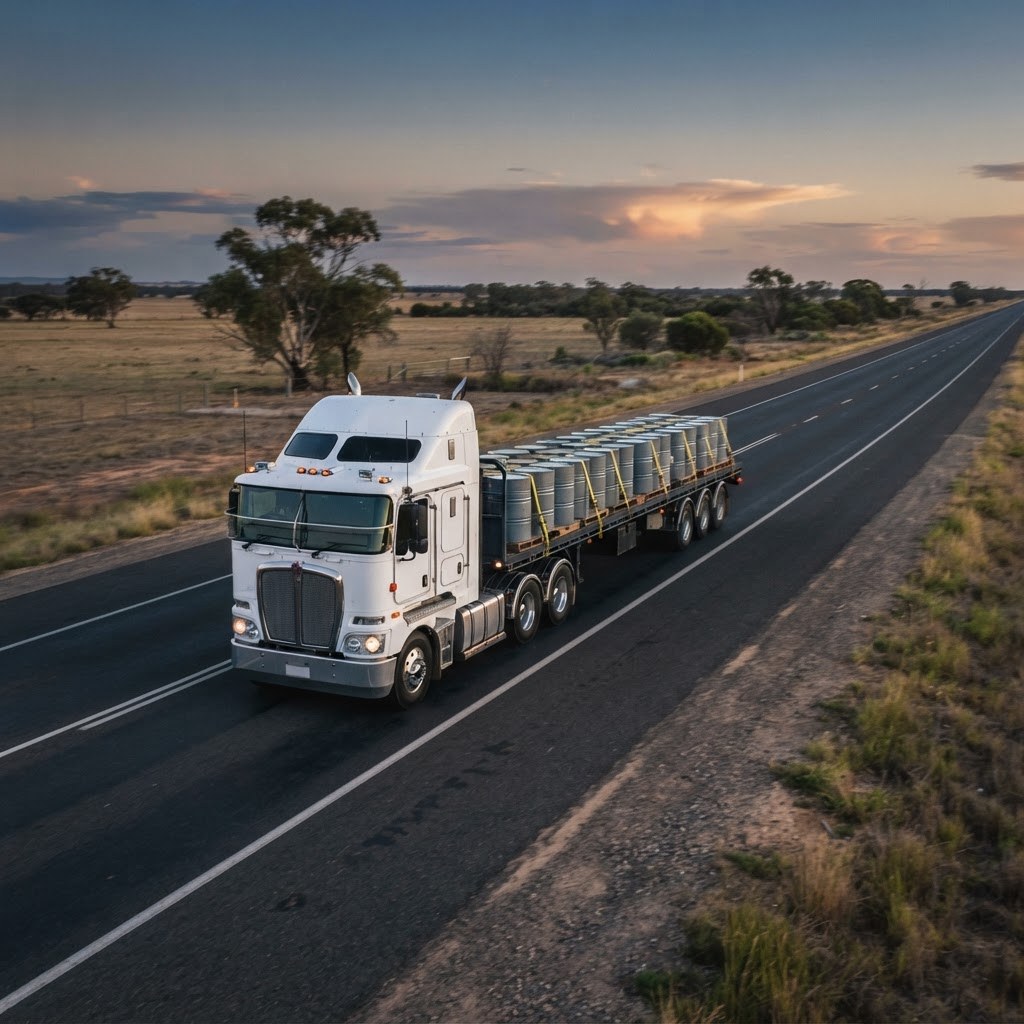
- Class 3 — Flammable Liquids (e.g. petrol): Packaged goods become placardable at 1,000 litres aggregate. Bulk loads (tankers) are always placardable.
- Class 8 — Corrosives (e.g. battery acid, caustic soda): Placardable at 1,000 litres or kilograms for Packing Group II/III substances.
- Class 6.1 — Toxic Substances: Thresholds vary significantly by substance — some are placardable at very small quantities, especially PG I substances.
- Class 2 — Gases (compressed, liquefied): Thresholds apply by cylinder quantity or aggregate capacity depending on the specific gas.
Always refer to the specific entry in the ADG Code for the exact substance you’re transporting. The proper shipping name, UN number, and packing group determine the applicable threshold.
What Happens Below the Placardable Quantity?
Loads below the placardable threshold are sometimes called non-placardable or limited quantity loads. Below the threshold, the vehicle is not required to be placarded.
However, even non-placardable loads must still be correctly packaged, labelled, and handled safely. Dangerous goods don’t become safe just because the quantity is small — the ADG Code still sets packaging and labelling standards for sub-threshold loads.
And if you’re carrying multiple classes of dangerous goods that are individually below threshold but collectively meet the placardable quantity, a special calculation applies — the ADG Code’s mixed load formula. Refer to the code directly or seek advice.
Not all dangerous goods transport requires a licence. Read our detailed guide: What Loads Require a Dangerous Goods Licence in NSW?
Important distinction — licence vs placard threshold: A dangerous goods driver licence is required if the vehicle carries DG in a receptacle with a capacity of more than 500 litres, or more than 500 kilograms of DG. This is a per-receptacle threshold, separate from the aggregate placard load quantities above. An exemption applies for IBCs with a total capacity of no more than 3000 litres, provided no IBC is filled or emptied while on the vehicle.
Need to get certified? Kells Safety Centre (RTO 91528) delivers Dangerous Goods Driver Licence (TLILIC0001) in Wetherill Park and Wollongong, NSW.
Read more: Dangerous Goods Driver Licence NSW: Who Needs It?
Mixed Loads — Calculating Aggregate Quantities
When a vehicle carries multiple types of dangerous goods from different classes, the ADG Code requires an aggregate quantity calculation to determine whether placarding is triggered. The formula compares the ratio of each substance’s quantity against its individual threshold and sums them.
If the aggregate calculation equals or exceeds 1, the load is placardable and full DG compliance requirements apply. This is a common area of confusion for businesses that believe small amounts of different DG substances are individually safe — the aggregate rule can catch them out.
Frequently Asked Questions
Where can I find the exact placardable quantity for my substance?
Look up the substance in the ADG Code Dangerous Goods List using its proper shipping name or UN number. The placardable quantity is listed in the applicable column. If you’re unsure, contact the manufacturer — the Safety Data Sheet (SDS) usually includes transport classification data.
Does placardable quantity apply to bulk liquids the same as packaged goods?
No. Bulk loads (tankers, IBCs over a certain capacity) typically trigger placarding obligations regardless of volume — the threshold concept applies primarily to packaged goods. Bulk dangerous goods are almost always placardable.
Can my load be placardable one day and not the next?
Yes — if quantities vary between runs. A load below threshold on a partial delivery may be placardable on a full-load run. This is why drivers and schedulers need to understand the threshold for every class they handle, not just a blanket rule.
What is the ADG Code placard threshold for Class 3 liquids in NSW?
For packaged Class 3 flammable liquids, the placardable quantity is generally 1,000 litres aggregate. For bulk Class 3 (e.g. petrol tankers), the load is always placardable. Check the specific UN entry in the ADG Code for your substance.
If you carry dangerous goods below the placard threshold, do I still need DG awareness training?
A DG licence isn’t required for sub-threshold loads. However, DG Awareness training is strongly recommended for anyone regularly handling or transporting any quantity of dangerous goods — and may be required under your employer’s WHS policy or Chain of Responsibility obligations. For regulatory details, refer to ADG Code placardable quantities.
Kells Safety Centre (RTO 91528) delivers the TLILIC0001 Dangerous Goods Licence course across NSW — covering ‘bulk’ quantities, documentation, and emergency response. View all courses and enrol today →
Common Mistakes With Placardable Quantities
These are the compliance errors NSW drivers and operators make most often around placardable quantities:
- Assuming smaller loads don’t trigger requirements: Mixed loads of different DG classes can aggregate to reach the placardable threshold even when each individual substance is below its limit.
- Using volume instead of mass: Placardable quantities are expressed in kilograms or litres depending on the substance — always check the ADG Code Dangerous Goods List for the correct unit.
- Not checking the packaging group: Packing Group I substances have lower placardable quantities than Packing Group III. The class alone doesn’t tell you the threshold.
- Treating exemptions as permanent: Exemptions under the ADG Code apply to specific transport scenarios. They don’t override NSW EPA licensing requirements for bulk loads.
If you transport goods that are near or at the ‘bulk’ threshold, the safest approach is to hold a Dangerous Goods Driver Licence (TLILIC0001) regardless. It removes ambiguity and demonstrates compliance to both employers and enforcement officers.
Visit Kells Safety Centre training courses to book TLILIC0001 or DG Awareness training in Wetherill Park or Wollongong, NSW.
Ready to Book Your Training?
Accredited transport safety courses — Wetherill Park & Wollongong. EPA processing included. RTO 91528.