
Every heavy vehicle operator in NSW knows the feeling: you spot an NHVR inspection station ahead or see enforcement officers on the roadside. If you are prepared, it is a non-event. If you are not, it can mean an on-the-spot fine, a vehicle defect notice, or worse.
This guide explains exactly what NHVR heavy vehicle inspectors check in NSW, what documents you must have in the cab, and what you can do right now to make sure your next inspection goes smoothly.
Who Are the NHVR Inspection Officers?
The National Heavy Vehicle Regulator (NHVR) is the national body responsible for heavy vehicle regulation across all states and territories except WA and NT. In NSW, NHVR authorised officers work alongside NSW Police and Transport for NSW in conducting roadside enforcement operations.
NHVR officers have the authority to stop heavy vehicles, inspect vehicles and loads, request documentation, direct vehicles to weigh stations, and issue infringement notices. They can also direct a vehicle not to continue until defects are rectified.
What Do NHVR Officers Check?
A standard NHVR roadside inspection in NSW typically covers several areas:
1. Driver Documentation
Officers will check that the driver holds the appropriate licences for the vehicle and load being carried. For dangerous goods loads, this means verifying the driver’s Dangerous Goods Driver Licence is current and appropriate for the class of DG being transported. A driver without a current DG licence transporting a bulk DG load faces an immediate infringement.
2. Fatigue Documentation
For drivers operating under Basic Fatigue Management (BFM) or Advanced Fatigue Management (AFM), the work diary must be current, correctly completed, and available for inspection. Officers check:
- That rest periods have been correctly recorded
- That work periods do not exceed the permitted limits for the driver’s fatigue category
- That the driver’s BFM accreditation is current
Missing or incorrectly completed work diaries are one of the most common infringement triggers at NHVR roadside checks.
3. Vehicle Mass and Dimensions
Officers may direct the vehicle to a weigh station to check axle mass, gross vehicle mass, and load dimensions. Overloading creates serious road safety risks and exposes both the driver and the operator to Chain of Responsibility liability.
4. Load Restraint
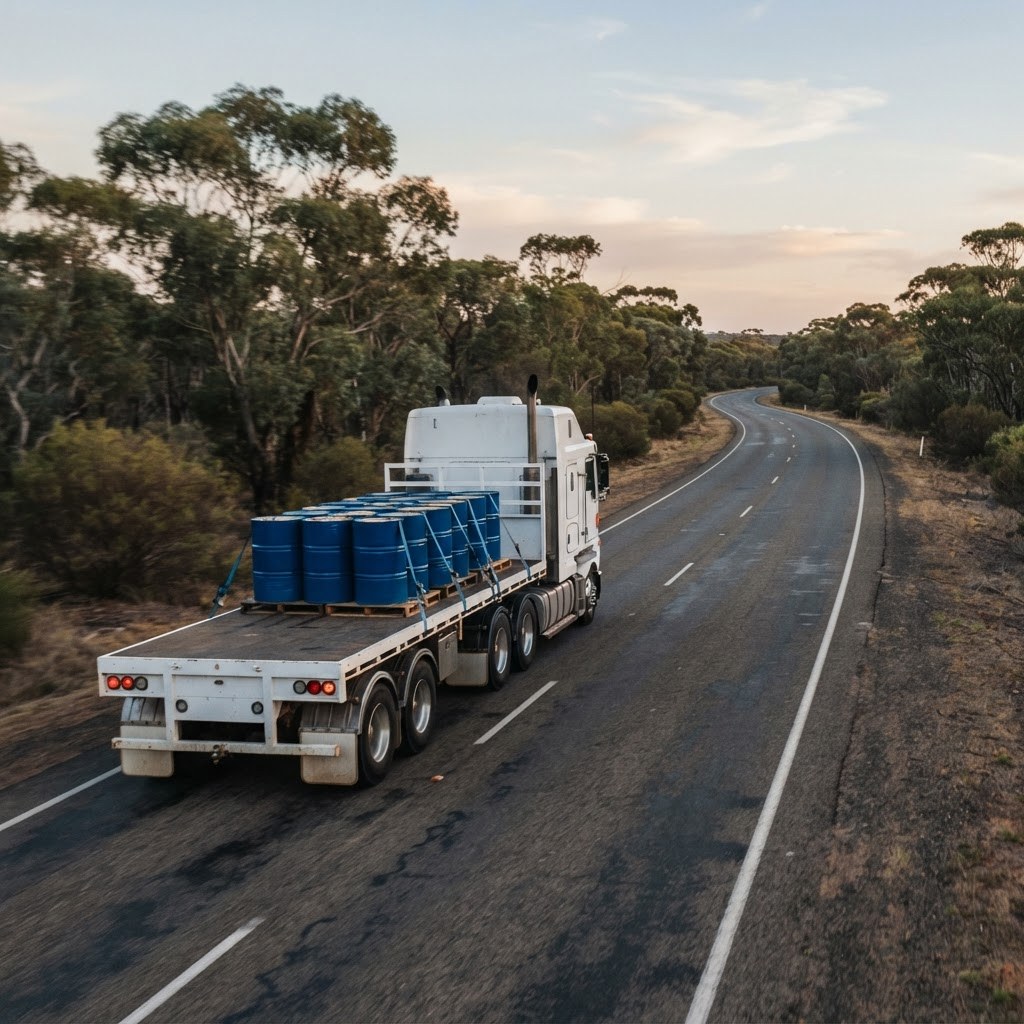
Load restraint compliance is checked under the Load Restraint Guide (LRG). Officers check that loads are secured in a way that prevents them from moving, falling, or creating a hazard. Safe Load Program (SLP) card holders are expected to demonstrate competency in load restraint — and inspectors know what correct restraint looks like.
5. Vehicle Condition and Safety Equipment
The vehicle itself is inspected for defects including brakes, tyres, lights, and structural integrity. For dangerous goods vehicles, this extends to:
- Correct dangerous goods placards displayed on all four sides of the vehicle
- Emergency Information Panel (EIP) displayed correctly
- Fire extinguisher present and current
- Emergency Procedure Guide (EPG) accessible in the cab
- Dangerous goods consignment note present and correctly completed
6. Dangerous Goods Documentation
For DG loads, the consignment note must be in the cab, correctly completed with all mandatory fields. Officers cross-check the consignment note against the actual load — the DG class, UN number, quantity, and proper shipping name must all match. Discrepancies attract infringement notices.
What Happens If You Fail an Inspection?
The consequences of a failed inspection depend on the nature and severity of the issue:
- Minor defects — the driver may receive a direction to have the defect rectified within a specified time period
- Serious defects — the vehicle may receive a defect notice requiring it to be taken off the road immediately
- Infringement notices — on-the-spot fines for specific offences (unlicensed DG driving, work diary failures, etc.)
- Load offences — overloading and load restraint failures attract significant penalties under the HVNL
- Referral for prosecution — serious or repeat offenders can be referred for prosecution, with penalties including substantial fines and COR liability for operators
The Pre-Trip Checklist That Prevents Most Inspection Failures
Most inspection failures are preventable. Before departing on any heavy vehicle run in NSW:
- ✅ Current DG Driver Licence in wallet (if carrying DG)
- ✅ Work diary completed and up to date (if on BFM/AFM)
- ✅ Consignment note in cab, fully completed
- ✅ EPG accessible in cab
- ✅ DG placards on all four sides of vehicle
- ✅ EIP displayed correctly (if carrying bulk DG)
- ✅ Fire extinguisher present and in date
- ✅ Load correctly restrained and within mass limits
- ✅ Vehicle lights, brakes, tyres — pre-trip check completed
Frequently Asked Questions
Can NHVR officers stop any heavy vehicle, or only those with DG loads?
NHVR officers can stop any vehicle that falls within the definition of a heavy vehicle (GVM over 4.5 tonnes) regardless of what it is carrying. The scope of the inspection will depend on the type of vehicle and load.
Do I have to stop at every inspection station?
Yes — if you are directed to stop, you must comply. Failing to stop for an authorised officer is an offence under the HVNL with significant penalties.
What if I’ve forgotten my work diary?
Failing to have a work diary available for inspection when required is an offence. Officers may direct you to produce the diary within a specified time, but in many cases an on-the-spot infringement will be issued. The BFM course at Kells Safety Centre covers correct work diary completion in detail.
What training helps the most with passing NHVR inspections?
For DG drivers: the TLILIC0001 DG Licence course covers all documentation, placarding, and load requirements. For fatigue compliance: the BFM course covers work diary requirements. For load restraint: the Safe Load Program covers LRG compliance. All available at Kells Safety Centre (RTO 91528).
Want to be fully prepared for your next NHVR inspection? Kells Safety Centre delivers the training that covers every aspect of heavy vehicle compliance.
View All Courses
Key Takeaways
- NHVR officers in NSW check driver licences, fatigue records, vehicle condition, load restraint, and DG documentation
- DG drivers must have a current licence, consignment note, EPG, placards, and EIP — all in order
- Most inspection failures are preventable with a thorough pre-trip check
- BFM, DG Licence, and SLP training from Kells Safety Centre (RTO 91528) covers all major inspection compliance areas
Roadside Inspection Categories
NHVR authorised officers conduct different types of inspections depending on the vehicle, load, and level of concern. The main categories relevant to NSW dangerous goods and fatigue compliance are:
- Basic inspection — document check, driver licence, load security visual assessment
- Standard inspection — full vehicle condition check, brake test, dimension and mass check
- Dangerous goods inspection — DG licence verification, consignment notes, placarding, segregation, EIP, EPG, emergency equipment
- Fatigue inspection — work diary, work and rest records, BFM/AFM logbook, fitness for duty assessment
Officers can conduct multiple inspection types in a single stop. A dangerous goods vehicle will typically receive both a DG inspection and a standard vehicle condition check simultaneously.
Your Rights and Obligations During an Inspection
NSW drivers and operators have both rights and obligations during NHVR roadside inspections. You are legally required to:
- Stop and submit to the inspection when directed by an authorised officer
- Produce your driver licence, DG licence (if applicable), and work diary on request
- Provide consignment documentation and dangerous goods information for the load
- Allow the officer access to the vehicle cab and load area
You are entitled to be treated professionally, receive written notice of any defects found, and request a review of any direction or notice you believe is incorrect.
Frequently Asked Questions
What happens if I fail an NHVR inspection?
The outcome depends on the nature and severity of the breach. Minor defects may result in a defect notice requiring repair within a set timeframe. More serious breaches — such as an unlicensed DG driver, no consignment note, or a vehicle deemed unsafe — can result in an on-the-spot infringement notice, a direction to cease operations, or the vehicle being placed off-road until the defect is rectified. Serious or repeat breaches can be referred for prosecution under the Heavy Vehicle National Law or the Dangerous Goods (Road and Rail Transport) Act 2008.
Can NHVR officers stop any heavy vehicle, or only specific types?
NHVR authorised officers have the power to stop and inspect any heavy vehicle (over 4.5 tonnes GVM) on public roads in NSW. They can also enter depots and operator premises for compliance checks. Dangerous goods vehicles of any size that are carrying a placard load may also be subject to inspection at any time.
Do I need my work diary with me at all times?
Yes. If you are operating under the Standard Hours or Basic Fatigue Management (BFM) fatigue law option, you must carry your current work diary and have it available for inspection at all times. The work diary must contain a complete and accurate record of your work and rest hours for the current day and the previous 28 days. Failure to produce a work diary — or producing an incomplete or false diary — is a serious offence under the Heavy Vehicle National Law.
What is an Inspection Management System (IMS) check?
NHVR authorised officers have access to the National Heavy Vehicle Inspection database. Before or during a stop, officers can check a vehicle’s registration, previous inspection history, operator compliance rating, and any outstanding defect notices. Vehicles or operators with poor compliance histories are more likely to be subjected to detailed inspections.
How does Chain of Responsibility affect my employer if I am pulled over?
Under Chain of Responsibility provisions in the Heavy Vehicle National Law, any breach found during a roadside inspection can potentially expose your employer, transport manager, or consignor to liability — not just you as the driver. If inspectors find that your work diary records systemic fatigue breaches or that your DG load was incorrectly prepared, the investigation can extend beyond the driver to the entire transport chain. Proper training — including BFM training and DG licence training — is your first line of defence.
What training helps me stay compliant during NHVR inspections?
The most directly relevant courses at Kells Safety Centre (RTO 91528) for NHVR inspection readiness are the Dangerous Goods Licence course (TLILIC0001) for DG compliance, and the Basic Fatigue Management (BFM) course (TLIF0005) for fatigue law compliance. Both courses cover exactly what inspectors look for — because both are built on the same legislation that inspectors enforce.
For regulatory guidance, refer to Safe Work NSW and the National Heavy Vehicle Regulator (NHVR).
Kells Safety Centre (RTO 91528) delivers the DG Licence and SLP courses at Wetherill Park (Western Sydney) and Wollongong, BFM at Wetherill Park, and the Blue Card and DG Awareness courses online.
View All Training Courses