
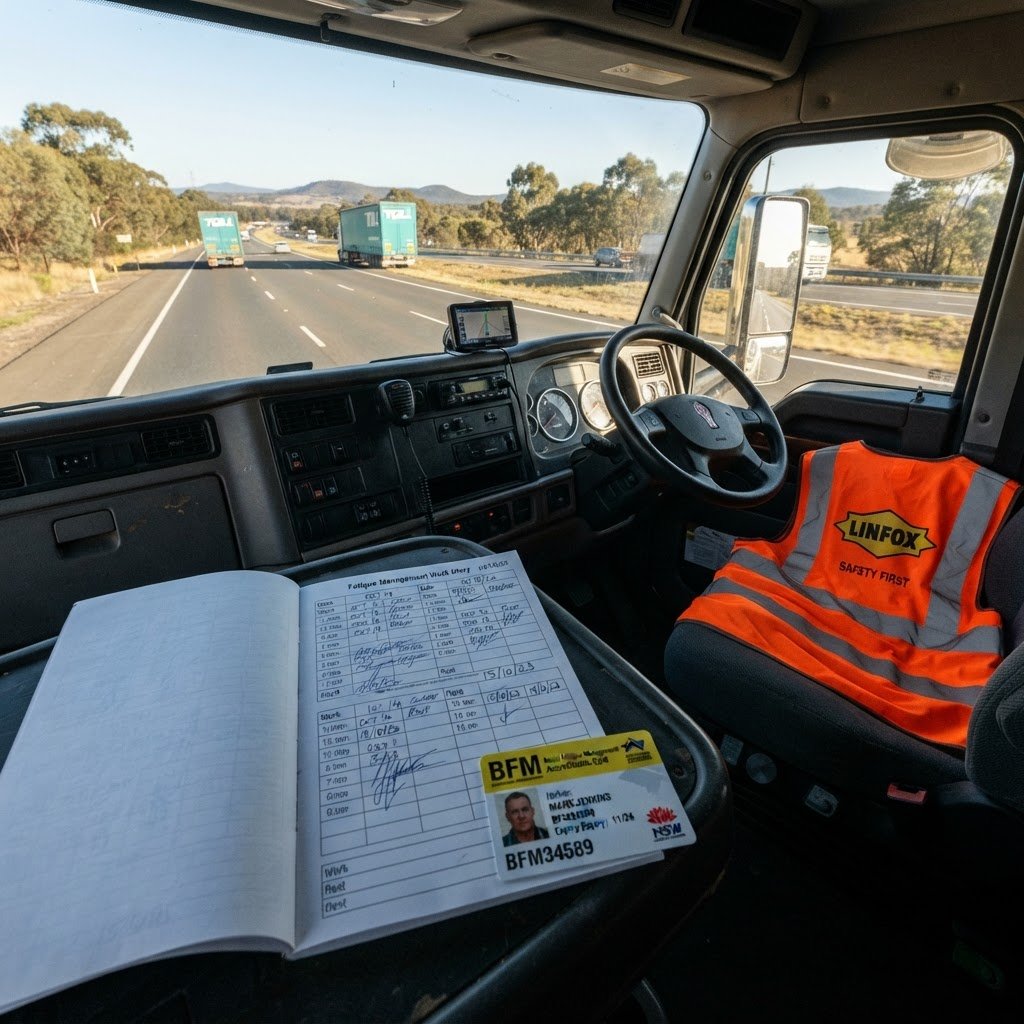
Quick answer: Advanced Fatigue Management (AFM) is the most flexible fatigue management option under the Heavy Vehicle National Law (HVNL), allowing operators to design tailored work and rest hours beyond the 14-hour daily limit available under Basic Fatigue Management (BFM). BFM is the starting point for most NSW operators — AFM is for those who can demonstrate a comprehensive fatigue management system and need even greater flexibility. Kells Safety Centre (RTO 91528) delivers BFM training (TLIIF0005) at Wetherill Park and Wollongong.
What Is Advanced Fatigue Management (AFM)?
Advanced Fatigue Management (AFM) is the highest-tier fatigue management accreditation under the HVNL, administered by the National Heavy Vehicle Regulator (NHVR). Unlike Standard Hours (max 12 hours work in 24) or BFM (max 14 hours work in 24), AFM allows operators to design their own work and rest schedules — tailored to their specific operations, routes, and risk profile.
AFM is a performance-based accreditation. Instead of prescribing fixed hour limits, the NHVR assesses whether the operator’s proposed schedule manages fatigue risk effectively. This means operators can potentially work longer shifts or adopt non-standard rest patterns — but only if they can prove their system manages fatigue safely.
AFM vs BFM: What’s the Difference?
The key difference is flexibility vs simplicity. Here’s how the three fatigue management tiers compare in NSW:
| Feature | Standard Hours | BFM | AFM |
|---|---|---|---|
| Daily work limit | 12 hours / 24 hrs | 14 hours / 24 hrs | Tailored (case-by-case) |
| Rest requirements | Prescribed breaks | More flexible breaks | Custom rest schedule |
| Accreditation required | No | Yes (NHVR) | Yes (NHVR + comprehensive system) |
| Weekly work limit | 72 hours | 144 hours / 14 days | Tailored to operation |
| Training needed | Basic induction | BFM course (TLIIF0005) | BFM + advanced SMS |
BFM gives operators an extra 2 hours per day over Standard Hours — enough for most NSW transport businesses. AFM goes further by removing fixed limits entirely, replacing them with an operator-specific fatigue management plan approved by the NHVR.
Who Needs AFM vs BFM in NSW?
Most NSW operators start with BFM and never need AFM. Here’s when each applies:
BFM is right for you if:
- You need up to 14 hours of work per 24-hour period
- You run predictable routes with manageable shift patterns
- You want a straightforward accreditation without a full Safety Management System
- Your drivers need a BFM course (TLIIF0005) to understand their obligations
AFM is right for you if:
- You need work hours beyond 14 per 24-hour period
- Your operations involve long-haul, remote area, or unusual shift patterns
- You have a mature Safety Management System (SMS) with documented fatigue risk controls
- You can demonstrate to the NHVR that your tailored schedule manages fatigue effectively
- You’re prepared for a rigorous accreditation audit process
How to Get BFM Accreditation in NSW
BFM accreditation requires completing a recognised Basic Fatigue Management course. Kells Safety Centre delivers this training at Wetherill Park and Wollongong. The course covers:
- NHVR fatigue management requirements and the HVNL
- Work and rest hour calculations under BFM
- Work diary obligations and record-keeping
- Recognising and managing fatigue risk
- Chain of Responsibility responsibilities
After completing the course, drivers and operators apply for BFM accreditation through the NHVR. The BFM course at Kells is a 1-day face-to-face session, with Statement of Attainment issued on completion.
Need your BFM accreditation?
Kells Safety Centre (RTO 91528) delivers TLIIF0005 Basic Fatigue Management courses at Wetherill Park and Wollongong.
How to Get AFM Accreditation in NSW
AFM accreditation is more complex than BFM. There is no single “AFM course” — instead, it’s an operator-level accreditation that requires:
- Existing BFM accreditation — most operators progress from BFM to AFM
- A comprehensive Safety Management System (SMS) — documenting how fatigue is managed across the operation
- A tailored work/rest schedule — proposed hours and rest patterns specific to your operation
- NHVR assessment — the regulator reviews your SMS and proposed schedule
- Regular auditing — AFM operators are subject to ongoing compliance audits
Drivers operating under AFM still need fatigue management training — the BFM course (TLIIF0005) provides the foundational knowledge. Schedulers need the Schedulers Fatigue Management course (TLIIF0006) to understand how their decisions affect driver fatigue.
NHVR Fatigue Rules Changing August 2026
The NHVR is introducing updated fatigue management rules from 1 August 2026, with a 3-year transition period. Key changes include:
- Updated work and rest hour options across all tiers
- Enhanced requirements for electronic work diaries
- Stronger Chain of Responsibility provisions for fatigue management
- New fatigue management exemptions and record-keeping requirements
If you’re currently on Standard Hours or BFM, you don’t need to panic — existing accreditations remain valid during the transition. However, now is the time to review your fatigue management approach and ensure your drivers are trained. See the NHVR fatigue management page for the latest updates.
Frequently Asked Questions
Is there an AFM course I can take?
There is no single “AFM course” like there is for BFM (TLIIF0005). AFM is an operator-level accreditation from the NHVR that requires a comprehensive Safety Management System. Drivers still need BFM training as the foundation, and schedulers need the Schedulers Fatigue Management course (TLIIF0006). Kells Safety Centre delivers both at Wetherill Park and Wollongong.
How many hours can you work under AFM?
AFM doesn’t set a fixed daily limit like Standard Hours (12) or BFM (14). Instead, the NHVR approves a tailored work and rest schedule based on your operation’s specific risk profile. The approved schedule becomes your legal limit.
Can I go straight to AFM without BFM?
Technically possible, but in practice most operators progress from BFM to AFM. BFM establishes the foundational fatigue management practices, driver training, and record-keeping systems that AFM builds on. Starting with BFM also demonstrates to the NHVR that you can manage fatigue under a structured framework.
Does Kells Safety Centre offer AFM training?
Kells Safety Centre delivers the BFM course (TLIIF0005) and Schedulers Fatigue Management course (TLIIF0006) — the foundational training required for AFM operators. The AFM accreditation itself is obtained through the NHVR, not an RTO. Contact Kells to discuss your fatigue management training needs.
What’s the difference between BFM and AFM accreditation costs?
BFM accreditation through NHVR involves a standard accreditation fee plus the BFM course fee. AFM accreditation is significantly more expensive — it requires a comprehensive SMS, NHVR assessment, and ongoing audits. Most NSW operators find BFM sufficient for their needs.
Do the new August 2026 NHVR rules affect my BFM accreditation?
Existing BFM accreditations remain valid during the 3-year transition period. The new rules introduce updated options but don’t automatically cancel current accreditations. However, operators should review the changes and plan for compliance within the transition window.
Where can I do a BFM course in NSW?
Kells Safety Centre (RTO 91528) delivers the BFM course (TLIIF0005) at Wetherill Park in Western Sydney and in Wollongong. The course is 1 day, face-to-face, with a Statement of Attainment issued on completion. View course details and enrol.
Do schedulers need separate fatigue management training?
Yes. Schedulers play a critical role in fatigue management under the Chain of Responsibility. The Schedulers Fatigue Management course (TLIIF0006) covers scheduling obligations, work/rest calculations, and how scheduling decisions impact driver fatigue. Kells delivers this course at both locations.
Get your fatigue management training sorted.
Kells Safety Centre (RTO 91528) delivers BFM and Schedulers Fatigue Management courses at Wetherill Park and Wollongong. Statement of Attainment issued on completion.