
Quick answer: If you’re transporting dangerous goods by road in NSW, you need TLILIC0001 (DG Licence Course) + NSW EPA licence under the ADG Code — not “shipping certification” in the maritime sense. Confusing the terms? You’re not alone. Kells Safety Centre (RTO 91528) can help clear it up.
What Is Dangerous Goods Shipping Certification? (The Confusion Explained)
“Dangerous goods shipping certification” means different things depending on your mode of transport. Most NSW business owners and logistics managers use the term thinking they need some kind of universal certificate to move hazardous materials. That’s where the confusion starts.
The reality: there’s no single “dangerous goods shipping certificate” in Australia. Instead:
- Road transport requires TLILIC0001 (DG Licence Course) + NSW EPA dangerous goods licence under the ADG Code
- Sea transport requires IMDG Code training + maritime credentials (separate system)
- Air transport requires IATA DGR training + CASA approval (separate again)
Because most NSW transport happens on roads, this post focuses on what you actually need for road transport — but we’ll touch on sea and air so you can tell the difference. This is why Kells Safety Centre (RTO 91528) specialises in road transport dangerous goods training across NSW.
Road Transport vs Sea vs Air: Which Rules Apply to You?
This is where most confusion happens. The term “shipping” implies maritime, but for NSW road operators, it’s irrelevant. Let’s separate them so you know exactly what applies to your business.
Road Transport (ADG Code + TLILIC0001 + EPA Licence)
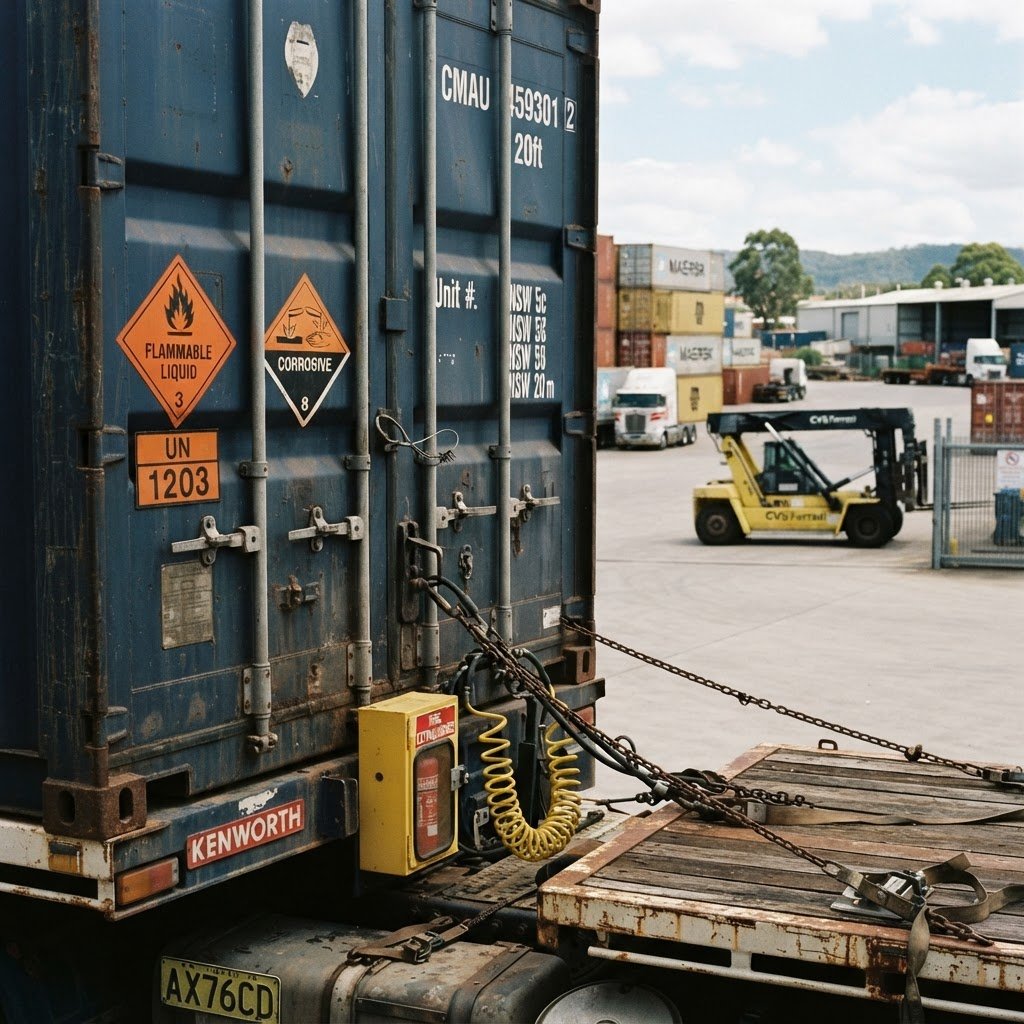
If you’re moving dangerous goods by truck in NSW, you operate under three legal frameworks set by NSW regulators:
- ADG Code — Australian Dangerous Goods Code. Sets what can be transported, how it’s packaged, labelling, placards, segregation rules. This is your transport rulebook.
- HVNL (Heavy Vehicle National Law) — Set by NHVR. Covers driver fatigue, chain of responsibility, safety obligations.
- NSW EPA Dangerous Goods Licences — Required if you manufacture, store, or transport DG above certain thresholds. Different from your driver’s TLILIC0001.
Your driver needs TLILIC0001 certification (delivered by registered RTOs like Kells Safety Centre). Your consignor/dispatcher needs to understand Prepare for Transport obligations under the ADG Code. Your business may need an EPA dangerous goods licence if you meet the threshold quantities.
This is the certification system NSW road operators use. It’s not called “shipping” — it’s road transport dangerous goods compliance.
Sea Transport (IMDG Code + Maritime Training)
If your goods go by ship, the rules change entirely. Maritime DG certification falls under the IMDG Code (International Maritime Dangerous Goods Code), administered by AMSA (Australian Maritime Safety Authority).
Sea transport training is a separate qualification — different from TLILIC0001, different curriculum, different assessors. You cannot substitute a road DG licence for maritime DG certification, and vice versa. Many NSW logistics companies handle both road and sea cargo, so some staff may need both qualifications — but they’re issued separately.
Air Transport (IATA DGR + CASA + Separate Certification)
Air freight has its own rules under IATA DGR (Dangerous Goods Regulations), managed by CASA (Civil Aviation Safety Authority). Again, separate training, separate certification. Not covered in depth in this post, but worth knowing it exists if you’re a national operator.
Do NSW Road Transport Operators Need a Separate Shipping Certificate?
No. If you’re moving dangerous goods on NSW roads, TLILIC0001 + EPA licence compliance is what you need. You don’t need maritime “shipping certification” — that’s only if you’re moving goods by sea.
But here’s what confuses people: some businesses think they need a “dangerous goods shipping certificate” as a universal catch-all. They don’t. They need:
- TLILIC0001 — driver/operator training certificate (road transport)
- EPA Dangerous Goods Licence — business compliance (if you meet threshold quantities)
- ADG Code knowledge — consignor/dispatcher obligations (often part of internal training or Prepare for Transport course)
That’s it. No separate “shipping cert” required for road transport.
What Does TLILIC0001 Actually Cover? (Your Real Road Transport Cert)
TLILIC0001 is the nationally recognised unit of competency for dangerous goods driver licensing in Australia. When you complete this course (delivered by Kells Safety Centre RTO 91528 or another registered RTO), you receive a Statement of Attainment that qualifies you to apply for your EPA-issued Dangerous Goods Licence Card.
The course covers:
- Classification of dangerous goods (9 classes under ADG Code)
- Labelling, placarding, and consignment note compliance
- Load segregation and vehicle compatibility
- Packing and documentation requirements
- Emergency response and incident procedures
- Chain of Responsibility (COR) driver obligations
This is road-specific training. It doesn’t cover maritime rules (IMDG), air rules (IATA), or consignor paperwork (that’s the Prepare for Transport course). But for drivers moving DG on NSW roads, TLILIC0001 is the foundation you need.
Consignor Obligations: Your Shipping & Transport Responsibilities
Here’s where the “shipping” side matters more: consignors (the businesses sending dangerous goods) have separate obligations under the ADG Code.
If you’re shipping (or transporting) DG on behalf of someone else — or preparing goods for transport — you must:
- Correctly classify and declare the goods (ADG Code)
- Ensure proper packing and labelling (ADG Code compliance)
- Provide a compliant dangerous goods consignment note to the carrier
- Ensure the transporter (driver) is licenced (TLILIC0001) and the vehicle is compliant
- Keep records for compliance audits and Chain of Responsibility
This is why some businesses send staff to the Prepare for Transport of Dangerous Goods course — it trains consignors and dispatchers on their ADG Code obligations, separate from driver training.
Key point: Drivers need TLILIC0001. Consignors/dispatchers need ADG Code and COR knowledge (often via the Prepare for Transport course). Both are part of compliance for NSW road transport.
How to Get DG Certification for Road Transport in NSW
If you need to move dangerous goods in NSW, here’s the path to becoming compliant:
- Enrol in TLILIC0001 — Available from any registered RTO (RTO 91528 = Kells Safety Centre NSW locations: Wetherill Park, Wollongong). Course is 2 days, delivered face-to-face. Online is not available for this unit.
- Complete the assessment — Written assessment + practical knowledge check on ADG Code.
- Receive your Statement of Attainment — Issued on the day if you pass.
- Apply for your NSW EPA Dangerous Goods Licence — Take your Statement of Attainment to the EPA. Submit proof of identity and medical certificate (heavy vehicle class). Processing time: 2–4 weeks.
- Receive your DG Licence card — Valid for 5 years. Renew every 5 years with a new medical and renewed training (refresher course recommended).
Cost: Kells charges $618 all-in for TLILIC0001 (includes EPA application support). EPA fees are separate.
Timeline: 2 days for course + 2–4 weeks for EPA processing = ready to work in 3–5 weeks.
Frequently Asked Questions — Dangerous Goods Shipping Certification NSW
What’s the difference between “shipping certification” and a DG licence?
“Shipping certification” usually means maritime DG training (IMDG Code). A DG licence (TLILIC0001) is for road transport. They’re completely separate. NSW road operators need the DG licence, not maritime shipping cert.
Do I need dangerous goods shipping certification if I drive in NSW?
Only if you drive heavy vehicles carrying dangerous goods on NSW roads. You’ll need TLILIC0001 + EPA DG Licence. If you’re moving goods by sea, that’s maritime training (IMDG Code) — a different cert entirely.
What is TLILIC0001 and how is it different from maritime DG training?
TLILIC0001 is the road transport DG course under the ADG Code — covers vehicle safety, placarding, segregation, emergency procedures. Maritime training (IMDG) covers ship stowage, maritime regulations, container codes. Different rules, different assessment, different cert. You need the one that matches your transport mode.
What does the ADG Code say about dangerous goods transport?
The ADG Code is the Australian rulebook for DG classification, packing, labelling, handling, and transport. It applies to all modes (road, sea, air) but each mode has additional rules on top. For road, it’s ADG Code + HVNL + EPA regs. For sea, it’s ADG Code + IMDG Code + AMSA. For air, it’s ADG Code + IATA + CASA.
Can I transport dangerous goods with just an IMDG Code certificate?
Not legally in NSW by road. IMDG is maritime only. If you’re driving a truck, you need TLILIC0001. If you have IMDG but not TLILIC0001, you cannot legally drive DG on NSW roads, and you risk NHVR penalty and Chain of Responsibility liability.
What’s a consignor obligation and why does it matter?
Consignors are the businesses sending or preparing DG for transport. They must ensure goods are correctly classified, packed, labelled, and documented under the ADG Code. If a consignor ships unsafe goods, they can be liable for incidents even if the driver did everything right. This is why Chain of Responsibility (COR) is so serious.
How long does it take to get DG road transport certification in NSW?
Course is 2 days (face-to-face at Kells Safety Centre). EPA processing is 2–4 weeks. Total: 3–5 weeks from course start to DG Licence card in hand. Kells runs courses regularly across Wetherill Park and Wollongong.
Who is Kells Safety Centre and why do businesses choose them for DG training?
Kells Safety Centre (RTO 91528) is a registered training organisation delivering dangerous goods (TLILIC0001), fatigue management (BFM), and transport safety courses across NSW for over 30 years. Businesses choose Kells because we handle EPA paperwork for you, deliver face-to-face at two convenient locations (Wetherill Park, Wollongong), and support you if you need a resit. We’re not a name-only RTO — we’re embedded in transport safety.
Is dangerous goods certification renewable? How often?
Yes. Your DG Licence card is valid for 5 years. After 5 years, you need to renew: new medical certificate + refresher training (optional but recommended) + EPA reapplication. Kells offers renewal courses designed for experienced drivers — shorter and focused on updates to the ADG Code.
Can I do dangerous goods transport training online in NSW?
No. TLILIC0001 is not available online in Australia. It must be delivered face-to-face because the assessment requires practical knowledge (vehicle compatibility, placard placement, loading scenarios). Kells delivers 2-day face-to-face courses at Wetherill Park and Wollongong. View our course dates and book here.
Key Takeaways
- ✅ NSW road transport needs TLILIC0001 + EPA licence (not maritime “shipping cert”)
- ✅ Maritime shipping needs IMDG Code training (separate from road DG, not what this article covers)
- ✅ Air transport needs IATA DGR training (separate again — not covered here)
- ✅ TLILIC0001 covers road-specific DG rules, placarding, segregation, Chain of Responsibility
- ✅ Consignors have separate ADG Code obligations — often trained via Prepare for Transport course
- ✅ Kells RTO 91528 delivers TLILIC0001 face-to-face in NSW — 2 days, EPA support included
- ✅ Cost: $618 all-in | Timeline: 2 days course + 2–4 weeks EPA = 3–5 weeks to licence
- ✅ Questions? Contact Kells Safety Centre for free advice on which course you need
Ready to get your dangerous goods certification for NSW road transport? Explore all our transport safety training courses — or book your TLILIC0001 course directly.