
Getting into dangerous goods transport in NSW means navigating several courses, licences, and cards — and it is not always obvious which one comes first. Get the order wrong and you can waste weeks waiting on a card you did not actually need yet, or worse, start driving before you are legally covered. Here is the exact pathway new DG drivers in NSW should follow, step by step.
Ready to start your dangerous goods career?
Step 1: Get Your Dangerous Goods Licence (TLILIC0001)
Every new DG driver in NSW needs to start here. The Dangerous Goods Driver Licence course (TLILIC0001) is the legal minimum requirement to transport dangerous goods on NSW roads — no exceptions. Without it, you cannot legally drive a vehicle transporting bulk DG, regardless of what other qualifications or experience you hold.
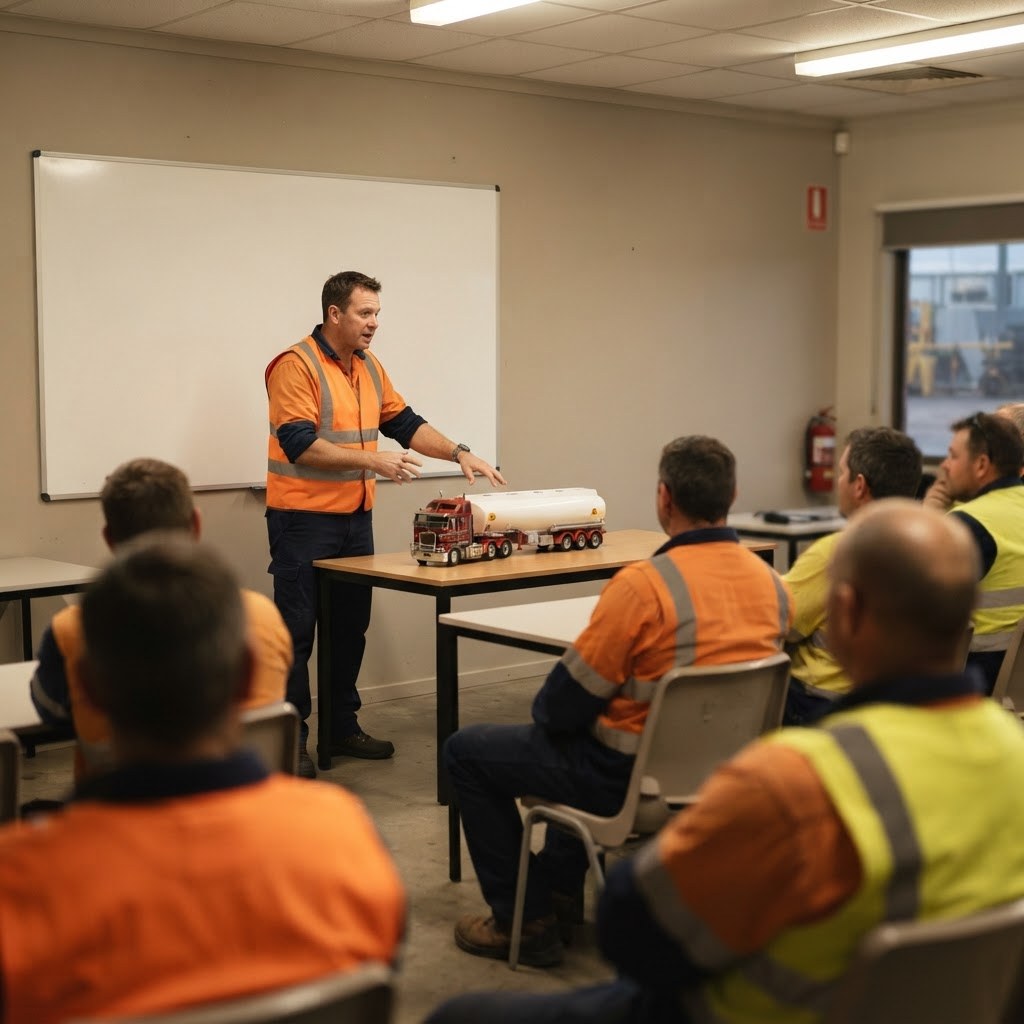
The course runs over 2 days face-to-face, covering the ADG Code, placarding, emergency procedures, documentation, and vehicle requirements. At the end you sit a written assessment, and on passing you receive a Statement of Attainment, which forms the basis of your NSW EPA dangerous goods driver licence application.
At Kells Safety Centre (RTO 91528), the DG Licence course runs regularly at both our Western Sydney and Wollongong locations, and we handle the EPA paperwork as part of the enrolment — so there is no separate admin step for you to chase up.
Step 2: Basic Fatigue Management (BFM) — If You Plan to Drive Long Hours
If your new role involves extended driving hours — interstate runs, long-haul freight, or rosters beyond standard hours — you will also need Basic Fatigue Management (BFM) accreditation (TLIF0005). BFM is not legally required for every DG driving role, but most transport operators running long-distance freight will not put a new driver on the roster without it, because it extends the legal driving hours available under the Heavy Vehicle National Law.
BFM covers fatigue risk factors, work diary requirements, and the rest and driving hour limits that apply under a BFM roster. It is a one-day course, and can usually be booked in the weeks following your DG Licence — many new drivers complete both within their first month.
Step 3: Blue Card — If Your Operator Requires It
The Blue Card course (TLIF0025) is an additional dangerous goods competency some transport operators require as a condition of employment, particularly for bulk fuel and chemical transport roles. It is not a universal legal requirement like the DG Licence, but if your prospective employer has listed it as a condition, you will need it before you can start.
Check your job description or ask your employer directly whether Blue Card is required for your specific role — it varies by company and by the type of dangerous goods being transported.
Step 4: Safe Load Program (SLP) Card — Common for Fleet and Contract Work
Fuel companies will require their drivers to hold a current Safe Load Program (SLP) card. SLP covers safety when entering fuel terminals, and allows the driver to enter fuel terminals and other fuel storage facilities in Australia.
If you are applying to multiple transport companies, having an SLP card already in hand alongside your DG Licence makes you a more employable candidate from day one — it signals you have already invested in the compliance side of the job.
Quick Summary: Your NSW DG Driver Pathway
| Step | Course | Required? | Typical Duration |
|---|---|---|---|
| 1 | Dangerous Goods Licence (TLILIC0001) | Legally mandatory | 2 days |
| 2 | Basic Fatigue Management (TLIF0005) | Required for extended hours rosters | 1 day |
| 3 | Blue Card (TLIF0025) | Employer-dependent | 1 day |
| 4 | Safe Load Program (SLP) Card | Employer/contract-dependent | 4 hours |
How Long Does It Take to Become Job-Ready?
Most new drivers can be fully job-ready — DG Licence issued and any additional cards completed — within 3 to 6 weeks, depending on EPA processing times and how many additional courses their role requires.
A practical approach many new drivers take: enrol in the DG Licence course first (it is the one course everyone needs), then speak to prospective employers about which of the additional cards — BFM, Blue Card, or SLP — they specifically require before committing time and cost to courses you may not need yet.
Why Start With Kells Safety Centre
Kells Safety Centre (RTO 91528) runs all four of these courses — the DG Licence and SLP at both our Western Sydney (Wetherill Park) and Wollongong locations, BFM at Wetherill Park, and the Blue Card online — meaning new drivers can complete their entire compliance pathway with one registered training organisation instead of chasing multiple providers. We also stock the safety equipment — placards, EIPs, PPE — that new DG drivers need once they are on the road.
Not sure which courses your new role requires?
Key Takeaways
- Every NSW DG driver must start with the Dangerous Goods Licence (TLILIC0001) — it is the non-negotiable legal minimum
- BFM accreditation is needed if your role involves extended driving hours beyond standard limits
- Blue Card and SLP card requirements vary by employer — check your specific job requirements before enrolling
- Most new drivers are job-ready within 3–6 weeks, or as little as 1–2 weeks for DG Licence alone
- Kells Safety Centre (RTO 91528) delivers all four courses across Western Sydney and Wollongong
Frequently Asked Questions
What is the very first course a new DG driver in NSW should take?
The Dangerous Goods Licence course (TLILIC0001) is always the starting point. It is the legal minimum requirement to transport dangerous goods in NSW, and every other course in the pathway (BFM, Blue Card, SLP) is an addition on top of this base requirement.
Do I need Basic Fatigue Management before I start driving?
Only if your role requires extended driving hours beyond standard limits under the Heavy Vehicle National Law. Many entry-level DG roles do not require BFM immediately — confirm with your employer whether your rostered hours require it before enrolling.
Can I do all four courses in one week?
It is possible to schedule DG Licence, BFM, Blue Card, and SLP in quick succession, but most new drivers space them out over 3–6 weeks based on employer requirements and course availability. Confirm with Kells Safety Centre what scheduling combinations are available at your preferred location.
Is the Blue Card the same as a DG Licence?
No. The DG Licence is the mandatory legal qualification to transport dangerous goods. The Blue Card is an additional competency some employers require for specific roles — it does not replace the DG Licence.
How much does it cost to complete the full new-driver pathway?
Costs vary depending on which combination of courses your role requires. Contact Kells Safety Centre directly for current course pricing and package options for new drivers completing multiple courses.
Does Kells Safety Centre help with EPA licence applications?
Yes. Kells Safety Centre handles the EPA paperwork as part of the DG Licence course enrolment, so new drivers do not need to navigate a separate application process after completing training.
For further guidance on licensing requirements, see the NSW EPA and the National Heavy Vehicle Regulator (NHVR).
Start Your Dangerous Goods Driving Career the Right Way
Kells Safety Centre (RTO 91528) delivers the full training pathway for new DG drivers across NSW — from your first Dangerous Goods Licence through to BFM, Blue Card, and SLP.