
Every dangerous goods vehicle in NSW must carry at least one fire extinguisher — but the type, size, and location are not up to you. The ADG Code specifies exactly what is required based on the class of dangerous goods you are carrying and the vehicle configuration. Carrying the wrong type or an undersized extinguisher is a compliance failure, full stop.
Need your DG licence to match your equipment? We can help.
What Does the ADG Code Require?
Under the Australian Dangerous Goods Code, all vehicles transporting dangerous goods at or above placard load must carry fire extinguishers. The requirements specify:
- Type: Dry chemical powder (DCP) extinguishers are the standard requirement for most dangerous goods transport
- Minimum capacity: 1.5kg for the vehicle cab; additional extinguishers required for the load area depending on vehicle type
- Accessibility: Must be accessible from outside the cab or the vehicle body
- Service: Must be maintained in serviceable condition — inspected and tagged as required by Australian Standard AS 1851
The specific requirements vary by dangerous goods class and vehicle configuration. Check the ADG Code for your specific load type, or confirm with your operator.
Dry Chemical Extinguishers: Which Size Do You Need?
Dry chemical powder extinguishers are the most widely used type for dangerous goods transport in Australia. They are effective on Class A (ordinary combustibles), Class B (flammable liquids), and Class C (flammable gases) fires — the most likely fire types in a transport incident involving common dangerous goods.
Kells Safety Centre (RTO 91528) stocks three sizes to cover all vehicle requirements:
1.5kg Dry Chemical Extinguisher
The minimum cab requirement under the ADG Code for most vehicle types. Compact, lightweight, and suitable for mounting in the cab or on smaller vehicles. The 1.5kg Dry Chemical Extinguisher from Kells is ADG Code compliant and ready for in-service use.
4.5kg Dry Chemical Extinguisher
The most common choice for prime movers and rigid trucks carrying packaged dangerous goods. Provides significantly more extinguishing capacity than the 1.5kg for a vehicle load area or second mounting point. The 4.5kg Dry Chemical Extinguisher suits most heavy vehicle operators.
9kg Dry Chemical Extinguisher
Required for some bulk tanker operations and larger vehicle configurations. The 9kg Dry Chemical Extinguisher is the high-capacity option for operators who need maximum fire suppression capability on board. Also commonly used at depots and loading facilities.
Extinguisher Bags and Brackets: Don’t Overlook Mounting
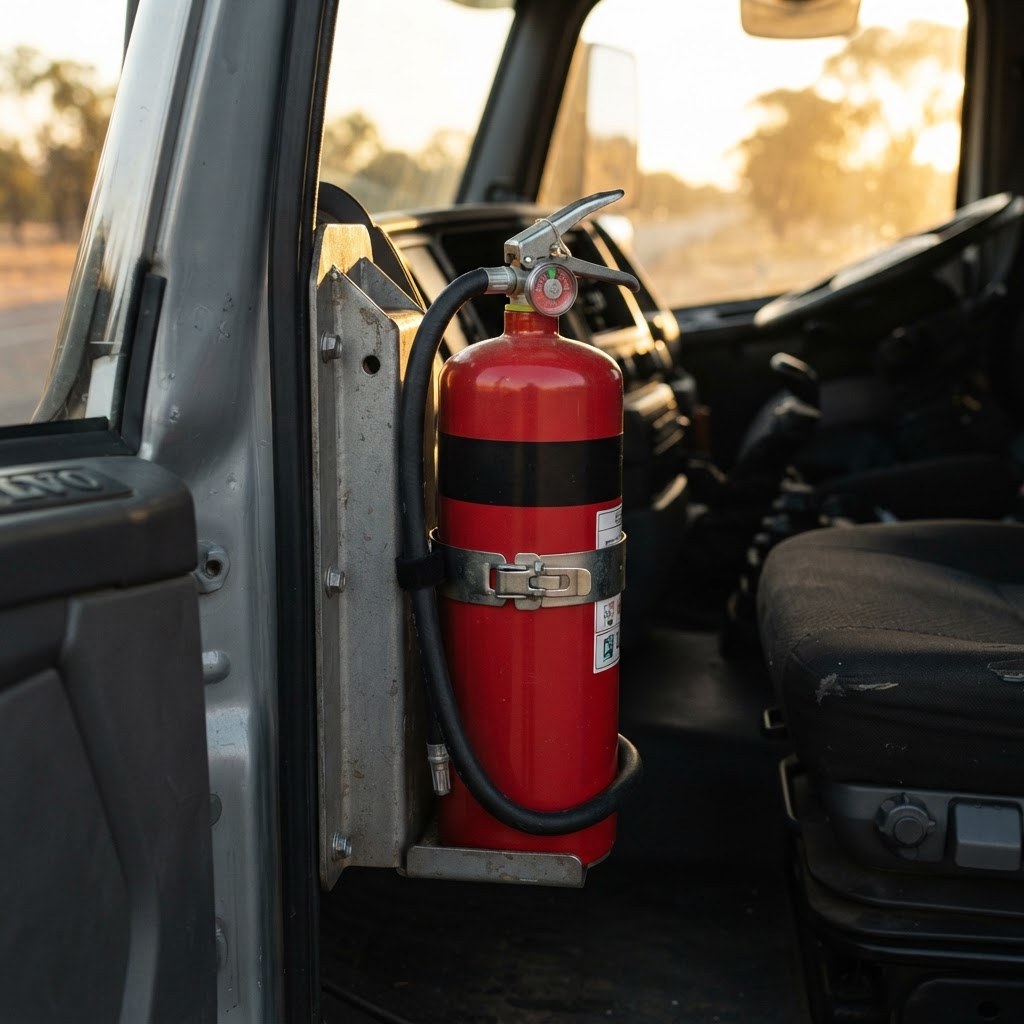
An extinguisher that is not properly mounted and accessible is effectively non-compliant — even if the extinguisher itself is the correct type and size. The ADG Code requires that cab extinguishers be accessible from outside the cab. Correct mounting is also essential for preventing damage to the extinguisher cylinder during transit on rough roads.
Kells stocks:
- Extinguisher Bag — protective carry bag for transport and storage, prevents cylinder damage
- Lightweight Extinguisher Bracket — mounts to cab interior, load area, or vehicle body. Keeps the extinguisher secure and accessible
A bracket-mounted extinguisher is always preferable to a loose extinguisher rolling around behind the seat — which creates both a compliance risk and a safety hazard.
Fire Blankets: Supplementary but Useful
Fire blankets are not specifically required under the ADG Code for most dangerous goods transport, but many operators include them as part of their on-vehicle emergency kit. A fire blanket is effective for smothering small Class A fires and protecting personnel during an emergency. Kells stocks Fire Blankets for operators who want a comprehensive vehicle emergency kit.
Extinguisher Maintenance: What the Law Requires
A fire extinguisher that cannot discharge effectively is useless in an emergency and will not pass a roadside inspection. Australian Standard AS 1851 governs the maintenance of fire protection systems and equipment, including portable extinguishers. Requirements include:
- 6-monthly inspection: Visual check and tag update by a licensed fire protection technician
- Annual inspection: More detailed check including pressure gauge and physical condition
- 5-yearly test: Hydrostatic pressure test of the cylinder
NHVR authorised officers check extinguisher tags at roadside inspections. An out-of-date tag — or a visibly damaged cylinder — will generate a defect notice.
What About Class-Specific Requirements?
Some dangerous goods classes have additional or different fire suppression requirements. Class 1 (explosives) transport, for example, has specific requirements that differ from standard DCP provisions. Class 2.1 (flammable gas) in bulk may require different extinguisher types depending on the specific product. Always check the ADG Code for your specific UN number and class — and confirm with your operator and the NSW EPA if uncertain.
For current NHVR compliance requirements, refer to the National Heavy Vehicle Regulator and Safe Work NSW.
Key Takeaways
- All DG vehicles at or above placard load must carry compliant fire extinguishers under the ADG Code
- Dry chemical powder (DCP) is the standard type for most dangerous goods transport
- Common ABE DCP sizes are 1.5kg, 4.5kg and 9kg — requirements are set as B-ratings under ADG Code Table 12.1, so match the size to the rating your load requires (confirm the B-rating on each extinguisher’s nameplate)
- Extinguishers must be mounted accessibly and maintained under AS 1851 — check tags at every pre-trip
- Kells Safety Centre stocks extinguishers, bags, and brackets for full vehicle compliance
Frequently Asked Questions
What size fire extinguisher is required on a dangerous goods truck in NSW?
The ADG Code requires a minimum 1.5kg dry chemical extinguisher in the cab of any vehicle transporting dangerous goods at placard load. Additional extinguishers of larger capacity (4.5kg or 9kg) may be required depending on vehicle type, load area, and the class of dangerous goods being transported.
Can I use a CO2 extinguisher on a DG vehicle?
CO2 extinguishers are not effective on Class B (flammable liquid) or Class C (flammable gas) fires and are generally not compliant for dangerous goods transport requirements. Dry chemical powder (DCP) extinguishers are the ADG Code standard. Check the specific requirements for your dangerous goods class before substituting extinguisher types.
How often do fire extinguishers on DG vehicles need to be serviced?
Under Australian Standard AS 1851, portable extinguishers require a 6-monthly inspection and tag by a licensed fire protection technician. Annual and 5-yearly tests are also required. NHVR inspectors check tags at roadside inspections — out-of-date tags generate defect notices.
Where should a fire extinguisher be mounted on a dangerous goods vehicle?
The ADG Code requires that cab extinguishers be accessible from outside the cab. This typically means mounting near the cab door at an accessible height. Use a proper extinguisher bracket — a loose extinguisher is both a compliance risk and a hazard in a crash.
Does Kells Safety Centre sell fire extinguishers?
Yes. Kells Safety Centre supplies 1kg, 1.5kg, 2kg, 2.5kg, 4.5kg, and 9kg dry chemical powder extinguishers, extinguisher bags, lightweight mounting brackets. Browse the range at Safety Equipment or visit our Wetherill Park location.
Shop Fire Extinguishers and Vehicle Safety Equipment
Kells Safety Centre supplies ADG Code-compliant fire extinguishers, mounting brackets, and vehicle emergency kits direct to DG operators across NSW. Online or in-store at Wetherill Park.
Need fire extinguisher training or DG licence courses? View all Kells Safety Centre training options in NSW.
Common Fire Extinguisher Mistakes for DG Drivers in NSW
One of the most common mistakes NSW dangerous goods drivers make is assuming a single extinguisher type covers all DG classes. This is incorrect. The ADG Code specifies different fire extinguisher ratings depending on the class of dangerous goods being transported. Another common error is failing to check the extinguisher service date before departure. All fire extinguishers on DG vehicles must be serviced every 6 months by a qualified technician, and the service tag must be visible and current at all times during transport.