
Unsecured loads kill. The National Transport Commission’s Load Restraint Guide (LRG) is the authoritative standard for safely securing loads on vehicles in Australia — and every heavy vehicle driver and transport operator in NSW should understand what it requires.
This guide explains what the Load Restraint Guide covers, who it applies to, how it connects to chain of responsibility, and where to get the official publication.
What Is the Load Restraint Guide?
The Load Restraint Guide (LRG) is a publication produced by the National Transport Commission (NTC) that sets out the performance standards and methods for restraining loads on road vehicles in Australia. The current edition is the Load Restraint Guide — 3rd Edition.
The LRG is referenced in the Heavy Vehicle National Law (HVNL) and associated regulations. In practice, it is the definitive industry reference for how loads must be secured — whether you’re carrying steel, timber, machinery, chemicals, or consumer goods.
Who Does the Load Restraint Guide Apply To?
The LRG applies to:
- Drivers of heavy vehicles — responsible for ensuring loads are restrained before and during transport
- Operators and fleet managers — responsible for ensuring vehicles are equipped with appropriate restraint systems and that drivers are trained
- Loaders and packers — chain of responsibility obligations extend to anyone who packs, loads, or secures a load
- Consignors — businesses sending goods have obligations if they influence how loads are packed or secured
Under the HVNL chain of responsibility provisions, everyone in the supply chain who contributes to an unsafe load can be held liable — not just the driver.
Load Restraint Performance Standards
The LRG sets out minimum performance standards for load restraint. A load must be restrained so that it can withstand forces in any direction equivalent to:
- 0.8g forward (braking force)
- 0.5g rearward
- 0.5g sideways
- 0.2g upward
These are not arbitrary numbers — they reflect the real-world forces experienced during emergency braking, cornering, and rough roads. A load that shifts or falls off a vehicle can cause a fatality or serious crash.
Load Restraint Methods Covered in the LRG
The LRG describes four primary methods for restraining loads:
- Blocking and bracing — using physical barriers (headboards, stakes, chocks) to prevent movement
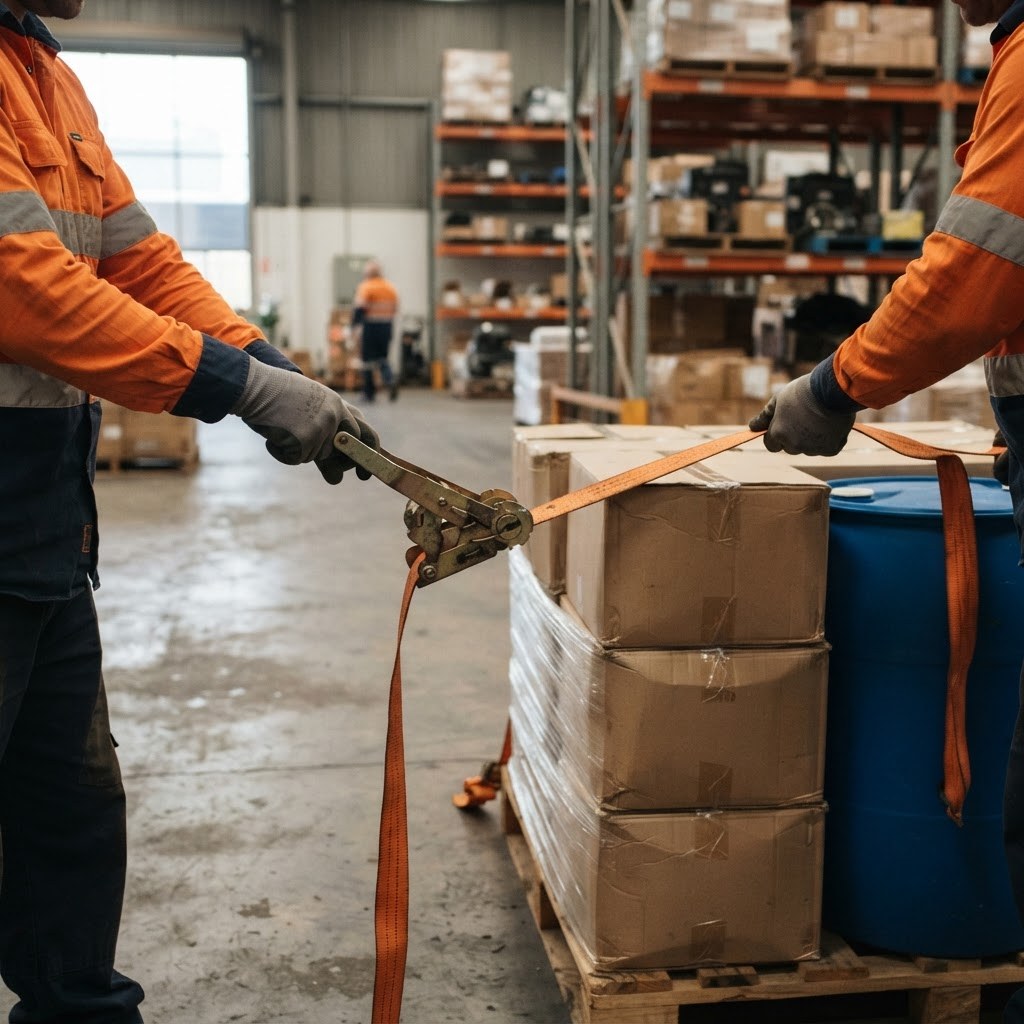
- Direct lashing — lashing straps, chains, or ropes attached directly to the load to prevent it moving
- Tie-down — straps applied over the top of the load to press it down onto the vehicle deck using friction
- Containment — enclosing the load in a container, box, or cage so it cannot shift
The method required depends on the type of load, its weight, shape, and whether it can be lashed directly. The LRG provides detailed guidance, diagrams, and worked examples for each method.
Safe Load Program (SLP) and Load Restraint
For drivers accessing petroleum terminals in NSW, the Safe Load Program (SLP) is a separate — and mandatory — requirement. The SLP covers the specific loading and unloading procedures for petroleum tankers, including hose connections, safe loading quantities, emergency shutoffs, and the SLP licence card requirement.
The SLP is not a substitute for general load restraint training — it’s specific to petroleum product loading at approved terminals. If your load isn’t petroleum product, the general LRG requirements apply.
Need to get certified? Kells Safety Centre (RTO 91528) delivers Safe Load Program (SLP) training in Wetherill Park and Wollongong, NSW.
Load Restraint and Chain of Responsibility
Under the HVNL, load restraint failures are not just a driver problem. The chain of responsibility provisions mean that:
- A scheduler who sets a delivery time that doesn’t allow for proper load securing can be held liable
- A loader who packs goods insecurely can be held liable even if they weren’t in the cab
- An operator who doesn’t provide appropriate restraint equipment or training can be held liable
The NHVR actively enforces chain of responsibility — and when an incident is investigated, the chain of decisions that led to an unsecured load is scrutinised, not just what the driver did on the day.
Where to Get the Load Restraint Guide
The Load Restraint Guide (3rd Edition) is available from the National Transport Commission’s website and as a physical publication. Kells Safety Centre stocks the LRG as part of its range of transport compliance reference publications — visit our safety equipment page to order a copy.
For hands-on training in load restraint principles, transport safety, and compliance — see our full range of transport safety courses.
Frequently Asked Questions
Is the Load Restraint Guide a legal document?
The LRG is not legislation itself, but it is referenced in the HVNL and heavy vehicle regulations. Compliance with the LRG is considered evidence of meeting the legal standard for load restraint. Deviation from the LRG doesn’t automatically mean non-compliance — but you’d need to demonstrate that your alternative method meets the same performance standards.
What are the penalties for an unsecured load in NSW?
Penalties under the HVNL for load restraint breaches vary depending on severity. A load that poses a safety risk can result in on-the-spot fines, vehicle detention until the load is secured, and subsequent investigation under chain of responsibility provisions that can result in significant penalties for operators and loaders.
Does the Load Restraint Guide apply to light vehicles?
The LRG primarily targets heavy vehicles. However, the same performance principles apply to all vehicles, and Australian Road Rules include requirements for load security on all vehicles. Utes, trailers, and light trucks are not exempt from the obligation to carry loads safely.
Where can I get transport safety training in NSW?
Kells Safety Centre (RTO 91528) delivers a full range of transport safety and compliance training, including the DG Driver Licence and Safe Load Program at Wetherill Park and Wollongong, BFM Fatigue Management at Wetherill Park, and the Blue Card online. View all courses or contact us for more information.
Transport safety training across NSW
Kells Safety Centre (RTO 91528) delivers accredited training for heavy vehicle drivers, operators, and transport businesses. Wetherill Park and Wollongong.
View All Training Courses →
For regulatory details, refer to NHVR Load Restraint Guide.
Ready to Book Your Training?
Accredited transport safety courses — Wetherill Park & Wollongong. EPA processing included. RTO 91528.