
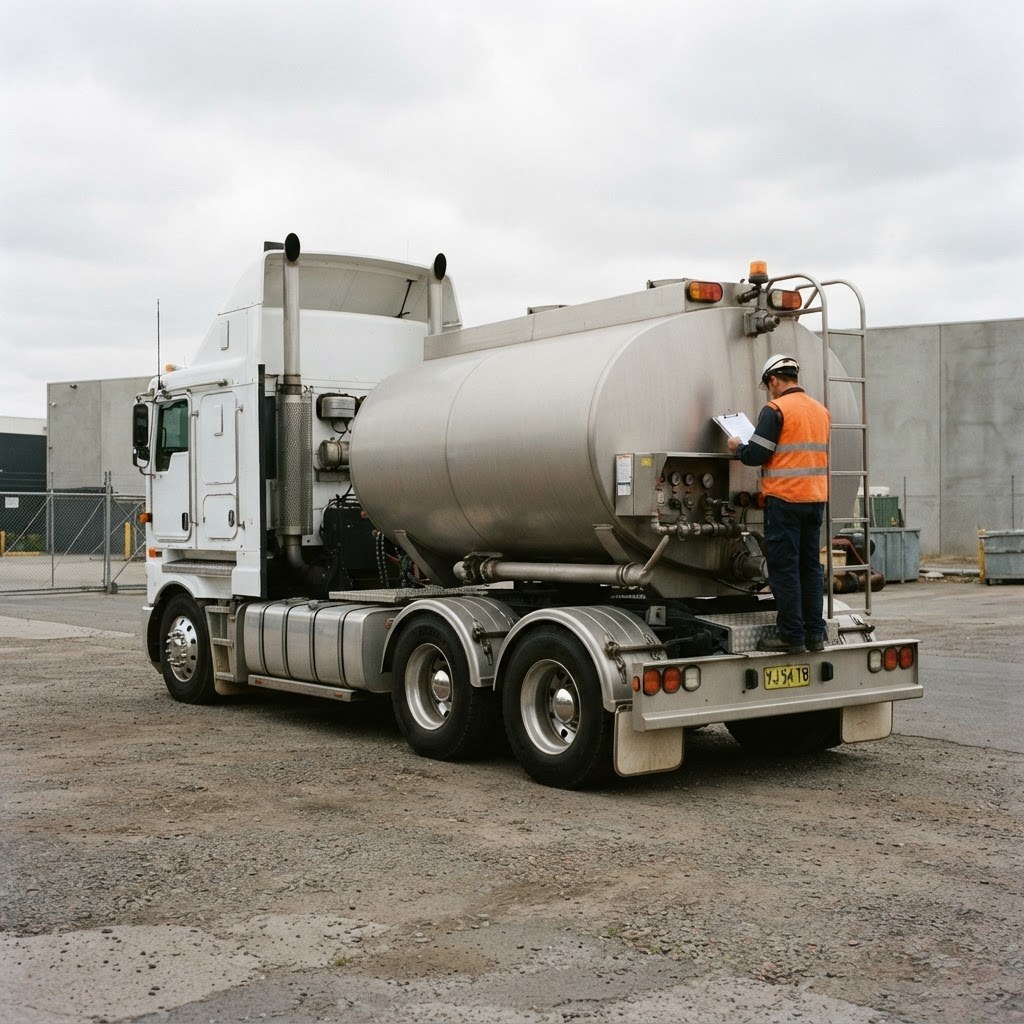
Fuel tanker drivers are among the most regulated heavy vehicle operators in NSW. They transport Class 3 flammable liquids — petrol and aviation fuel — in large bulk quantities, which puts them firmly under the ADG Code. So yes, if you drive a fuel tanker in NSW, you need a dangerous goods driver licence.
But there’s more to it than a yes/no answer. Here’s exactly what’s required, what the licence covers, and what additional certification applies specifically to fuel tanker operations.
Kells Safety Centre (RTO 91528) delivers the TLILIC0001 Dangerous Goods Licence course at Wetherill Park and Wollongong. View all courses →
Do Fuel Tanker Drivers Need a DG Licence in NSW?
Yes — and it’s not negotiable. Petroleum products including petrol and aviation fuel are classified as Class 3: Flammable Liquids under the Australian Dangerous Goods (ADG) Code.
Any driver transporting dangerous goods in bulk on NSW roads — in a receptacle with a capacity of more than 500 litres, or containing more than 500 kilograms — must hold a current Dangerous Goods Driver Licence, formally known as TLILIC0001, issued by the NSW EPA.
Driving a fuel tanker without a valid DG licence is an offence. Penalties include fines for the driver, potential prosecution, and chain of responsibility liability for the employer and scheduler.
What Does a DG Licence Cover for Fuel Tanker Drivers?
The TLILIC0001 unit of competency — completed at an accredited RTO like Kells Safety Centre — certifies that a driver can:
- Identify and classify dangerous goods by hazard class (including Class 3 flammable liquids)
- Read and interpret dangerous goods placards, labels, and emergency information panels
- Understand ADG Code requirements for transport, placarding, and documentation
- Complete and verify transport documentation
- Apply emergency response procedures at a DG incident
The DG licence is valid for 5 years from the date of issue. After that, the driver must renew through refresher training and re-application to the NSW EPA. See our guide: Dangerous Goods Licence Renewal NSW: What Drivers Need to Know.
Fuel Tanker Drivers Also Need an SLP Card
Here’s the part many people miss: in addition to a DG licence, petroleum tanker drivers in NSW are required to hold a Safe Load Program (SLP) licence card.
The SLP is a load restraint and petroleum tanker safety program administered by the SLP Administration. It covers:
- Safe loading and unloading of petroleum tankers
- Load restraint and stability requirements specific to bulk liquid transport
- Hose and coupling procedures
- Spill prevention and emergency shutdown
The SLP card is obtained by completing a 1-day accredited training course — typically run on Day 2 of the DG Licence course at Kells. The SLP card fee ($200) is paid separately to SLP Administration, not to the RTO.
Full details: Safe Load Program (SLP) course at Kells Safety Centre.
What About Drivers Who Only Occasionally Drive Fuel Tankers?
The licence requirement is based on what you’re carrying — not how often you carry it. If a driver is rostered to drive a fuel tanker on any given day, they must hold a current DG licence and SLP card for that shift. There is no exemption for occasional or casual drivers.
Employers who roster unlicensed drivers on fuel tanker runs face Chain of Responsibility liability. Schedulers who dispatch a driver without checking licence currency can also be held accountable.
Need to get certified? Kells Safety Centre (RTO 91528) delivers TLILIC0001 Dangerous Goods Driver Licence in Wetherill Park and Wollongong, NSW.
The Safe Load Program course runs concurrently with the DG Licence course at Wetherill Park and Wollongong.
Fatigue Management for Fuel Tanker Drivers
Fuel tanker drivers on long-haul or multi-stop runs may also need to operate under an NHVR fatigue management option. If your operation requires more than 12 hours of work in a 24-hour period, Standard Hours will not be sufficient — Basic Fatigue Management (BFM) training is required.
See our guide: Heavy Vehicle Fatigue Management Rules in NSW: 2026 Guide.
Frequently Asked Questions
Can I drive a fuel tanker with just a heavy vehicle licence and no DG licence?
No. A heavy vehicle licence (MC, HC, or HR) covers the vehicle — it does not authorise you to transport dangerous goods. A separate DG licence (TLILIC0001) is required for any bulk DG load, including fuel.
How long does it take to get a DG licence for fuel tanker driving in NSW?
The TLILIC0001 course at Kells Safety Centre runs over 2 days. The NSW EPA then processes your licence application — allow additional time for the EPA to issue the licence after your Statement of Attainment is submitted.
Is the SLP card the same as a DG licence?
No. They are separate qualifications. The DG licence (TLILIC0001) is issued by the NSW EPA and covers all dangerous goods transport. The SLP card is issued by SLP Administration and is specific to petroleum tanker operations.
What if my DG licence expires while I’m still driving a fuel tanker?
An expired DG licence means you are no longer licensed to transport bulk DG. You must stop transporting bulk DG loads immediately and complete renewal training before resuming.
Kells delivers both qualifications in a combined training block at Wetherill Park and Wollongong. RTO 91528. View courses and enrol today →
Ready to Book Your Training?
Accredited transport safety courses — Wetherill Park & Wollongong. EPA processing included. RTO 91528.