
A dangerous goods spill on a NSW road is a Chain of Responsibility event — not just a cleanup problem. How you respond in the first five minutes determines whether a contained minor incident becomes a major environmental and regulatory enforcement issue. Having the right spill kit on board, and knowing how to use it, is a legal obligation — not an optional extra.
Know your spill response obligations? The DG Licence course covers it.
Why Spill Response Is a Legal Obligation
Under environmental and safety laws, a dangerous goods spill must be contained and reported. Drivers have an immediate duty to take all practicable steps to prevent the spread of spilled material, protect the public and environment, and notify emergency services. Failing to respond appropriately — or not having the equipment to respond — may result in your becoming liability under the law.
Operators and consignors share this liability under Chain of Responsibility. If a driver cannot respond to a spill because they were dispatched without a compliant spill kit on board, the operator carries the exposure.
What Is a Transport Spill Kit?
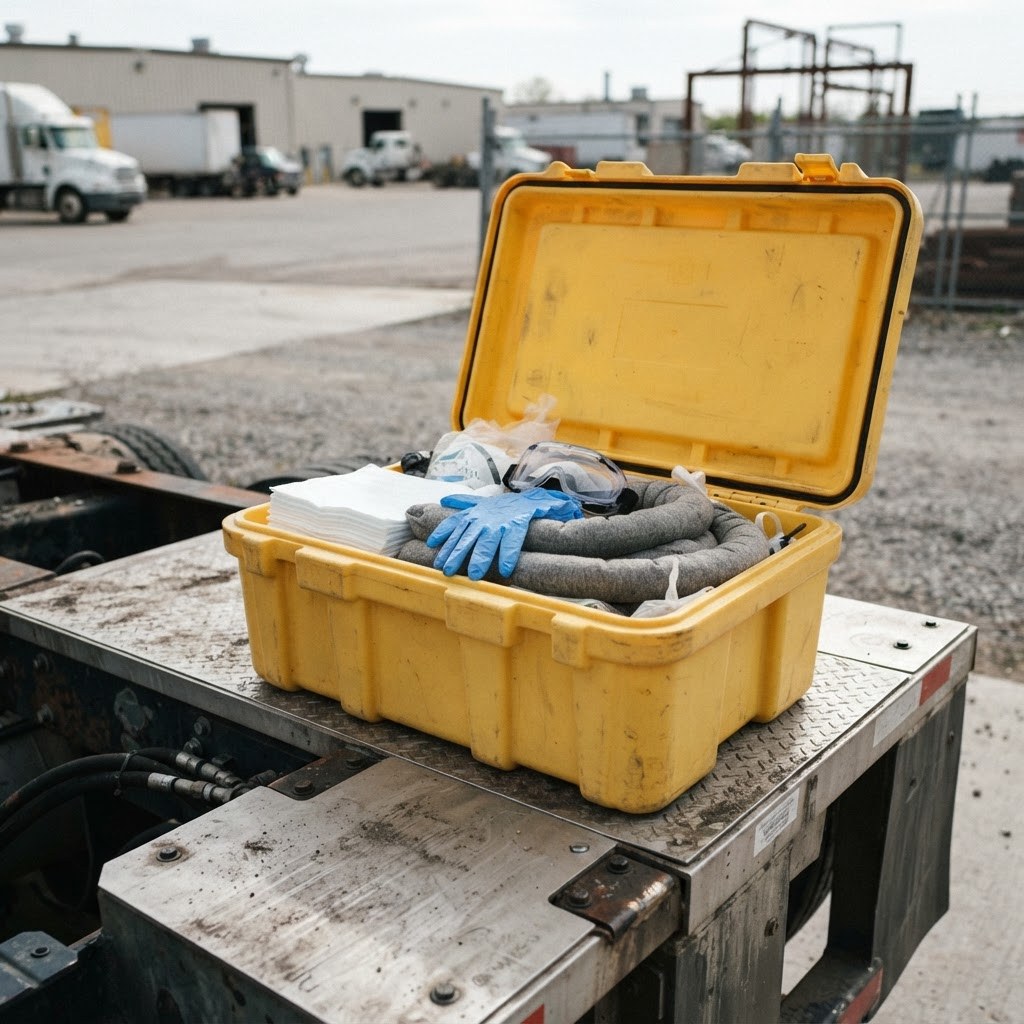
A transport spill kit is a compact, vehicle-ready spill response kit designed for the emergency containment of dangerous goods spills during road transport. It differs from a depot or facility spill kit in its size, portability, and focus on immediate containment rather than full remediation.
A compliant transport spill kit for dangerous goods transport typically includes:
- Absorbent socks — for perimeter containment around a spill
- Absorbent pads — for direct application to a liquid spill
- Absorbent granules or loose absorbent — for coverage of larger spill areas
- Disposal bags — for contaminated absorbent materials
- Chemical-resistant gloves and goggles (may be included or separate)
- Instruction card for use
Kells Safety Centre stocks the Transport Spill Kit — compact, vehicle-ready, and appropriate for most packaged dangerous goods transport operations.
Chemical Absorbent: What It Is and When You Need It
Loose chemical absorbent is used to cover and absorb liquid spills on road surfaces, in vehicle compartments, or in loading areas. It is particularly useful for larger spill areas where absorbent pads and socks cannot provide adequate coverage.
Chemical Absorbent from Kells is appropriate for use with most Class 3 (flammable liquid), Class 8 (corrosive), and Class 6 (toxic liquid) spills. It is a mineral-based absorbent that immobilises the liquid, reducing vapour generation and preventing further spread.
Important: chemical absorbent used in a dangerous goods spill is classified as chemical waste. It cannot be disposed of in a general waste bin — it must be bagged, labelled, and disposed of through a licensed chemical waste contractor. Your Emergency Procedure Guide will specify disposal requirements for your specific UN number.
General Chemical Spill Bin: For Fixed Locations
If you operate a depot, loading area, or fixed facility where dangerous goods are regularly handled, a portable General Chemical Spill Bin provides a permanently positioned spill response resource at the point of risk. Spill bins are stocked with absorbent materials and kept in high-risk areas for immediate access — they are not designed to be carried on a vehicle but are an essential part of any fixed dangerous goods handling area.
Class-Specific Spill Kit Requirements
Not all dangerous goods spills can be managed with the same absorbent materials. Some classes and specific UN numbers require class-specific spill response equipment:
- Class 8 Corrosives: Strong acids and alkaline solutions may require neutralising agents in addition to absorbents. Check your EPG.
- Class 6 Toxics: Spills of toxic liquids require full PPE (gloves, goggles, coveralls) before any contact with spilled material. Absorbents can be used but personnel must not touch contaminated absorbent with bare hands.
- Class 3 Flammable Liquids: Standard mineral absorbents are appropriate. Keep all ignition sources — including running engines — away from the spill area. A flameproof torch is required if working in the area after dark.
- Class 9 Miscellaneous: Requirements vary significantly by UN number — always check the EPG.
What to Do at the Scene of a Dangerous Goods Spill
The Emergency Procedure Guide (EPG) carried in your cab is your primary reference at the scene of a spill. The general sequence is:
- Stop safely — do not continue driving a leaking vehicle
- Assess the hazard — identify the UN number and reference your EPG
- Don PPE before approaching the spill — gloves and goggles minimum
- Call emergency services — 000 — and CHEMCALL (1800 039 008) if required
- Deploy absorbent socks to contain the perimeter
- Apply absorbent pads or granules to the spill
- Bag and label contaminated absorbent
- Report the incident to your operator and the NSW EPA as required
Do not attempt to clean up a spill involving high-toxicity, radioactive, or explosive materials without specific training and equipment. These require specialist hazmat response. For regulatory guidance, see NSW EPA and Safe Work NSW.
Key Takeaways
- Dangerous goods drivers must carry a transport spill kit — not having one is a compliance failure
- Spill response is a legal obligation under the ADG Code and NSW environmental legislation
- Operators and consignors share Chain of Responsibility liability for inadequate spill preparedness
- Class-specific requirements apply — check your Emergency Procedure Guide for your specific UN number
- Kells Safety Centre stocks transport spill kits, chemical absorbent, and fixed spill bins for facilities
Frequently Asked Questions
Is a spill kit required on all dangerous goods vehicles?
The law requires that drivers have the means to respond to a spill of the dangerous goods they are carrying. For liquid dangerous goods at placard load, a compliant transport spill kit is effectively mandatory. The specific requirements depend on the class of dangerous goods — check the ADG Code and your Emergency Procedure Guide.
What is the difference between a transport spill kit and a facility spill kit?
A transport spill kit is compact, vehicle-portable, and designed for immediate containment of a small dangerous goods spill at a roadside incident. A facility spill kit is larger, depot or warehouse-based, and designed for the management of larger spills in a fixed location. Both are needed — one on the vehicle, one at the loading point.
Can I use any absorbent material for a dangerous goods spill?
No. Standard cat litter or general purpose sawdust are not adequate for dangerous goods spills and may be reactive with some substances. Use chemical-specific absorbent appropriate for the class of goods spilled. Check your Emergency Procedure Guide for the specific absorbent requirements for your UN number.
What do I do with contaminated spill kit materials after a DG spill?
Contaminated absorbent materials are classified as chemical waste and cannot go in general waste. They must be placed in sealed, labelled disposal bags and removed by a licensed chemical waste contractor. Your Emergency Procedure Guide will specify disposal requirements for your specific dangerous goods class.
Where can I buy a dangerous goods spill kit in NSW?
Kells Safety Centre stocks the Transport Spill Kit, Chemical Absorbent, and General Chemical Spill Bin – browse our wide range of safety equipment at Safety Equipment. We also stock the full range of PPE required for safe spill response.
Spill Kits and Chemical Absorbent at Kells
Transport spill kits, chemical absorbent, and facility spill bins — available online and in-store at Kells Safety Centre, Wetherill Park NSW.