
Every dangerous goods vehicle in NSW must carry fire extinguishers that meet specific B-rating requirements under the Australian Dangerous Goods Code (ADG Code). The B-rating — 10B, 30B, 60B, or 80B — indicates the extinguisher’s firefighting capacity against Class B flammable liquid fires. Getting the wrong rating is a compliance failure, not a cost-saving decision. Kells Safety Centre (RTO 91528) has trained NSW DG drivers for over 30 years, and we stock the full range of ADG Code-compliant dry chemical powder extinguishers through our safety equipment shop. This guide breaks down exactly what each B-rating means, which one your vehicle needs, and how the ADG Code requirements map to real-world truck configurations.
DG vehicles in NSW need fire extinguishers with specific B-ratings based on load type and vehicle configuration. Packaged DG and non-flammable IBCs (up to 10,000L): 1 x 30B DCP in the cabin. Non-flammable goods in tanks or bulk containers: 1 x 60B (or 2 x 30B) plus 1 x 10B in cabin. Flammable goods in tanks or large IBCs: 2 x 60B, or 1 x 80B plus 1 x 20B foam, plus 1 x 10B in cabin. All extinguishers must comply with AS/NZS 1841 and AS/NZS 1850. As a guide, a 1.5kg ABE DCP is commonly rated around 30B, a 4.5kg around 60B and a 9kg around 80B — but ratings vary by manufacturer, so always confirm the B-rating printed on the extinguisher’s nameplate.
What Is a Fire Extinguisher B-Rating?
In Australia, portable fire extinguishers are tested and rated under AS/NZS 1850 and AS/NZS 1841. The rating tells you exactly what size fire the extinguisher can suppress. The number before the letter represents the size of the test fire — the higher the number, the larger the fire the extinguisher can handle.
For Class B fires (flammable liquids like petrol, solvents and paint), the B-rating is the critical number for DG transport. Possible B-ratings range from 2B up to 80B. The ADG Code Table 12.1 specifies which B-ratings are required based on what you’re carrying and how it’s packed.
Here’s how common dry chemical powder (ABE) extinguisher sizes map to their B-ratings:
| Extinguisher Size | Typical Fire Rating* | Typical Use |
|---|---|---|
| 0.75kg ABE DCP | 1A:10B:C:E | Cabin extinguisher (minimum for bulk loads) |
| 1.0kg ABE DCP | 2A:20B:C:E | Small load area or foam alternative |
| 1.5kg ABE DCP | 2A:30B:C:E | Cabin extinguisher (standard for packaged DG) |
| 2.5kg ABE DCP | 4A:40B:C:E | Light commercial / general transport |
| 4.5kg ABE DCP | 6A:60B:C:E | Load area (bulk non-flammable goods) |
| 9.0kg ABE DCP | 6A:80B:C:E | Load area (flammable bulk / tanker operations) |
*Typical ratings only — B-ratings vary by manufacturer and size. Always confirm the rating on each extinguisher’s nameplate.
ABE dry chemical powder is the standard for DG transport because it covers Class A (combustible solids), Class B (flammable liquids), Class C (flammable gases) and Class E (electrical) fires — the most likely fire types in a transport incident.
Need the right extinguisher for your DG vehicle? Kells Safety Centre stocks ADG Code-compliant ABE dry chemical powder extinguishers in 1.5kg, 4.5kg and 9kg sizes — all with mounting brackets and AS/NZS 1841 certification.
ADG Code Fire Extinguisher Requirements: Table 12.1 Explained
Under ADG Code Clause 12.1.2, every road vehicle transporting a placard load of dangerous goods must carry fire extinguishers that meet Table 12.1 requirements. The requirements depend on what you’re carrying and how it’s packed. Here’s the breakdown:
1. Packaged DG and Non-Flammable IBCs (Up to 10,000L or 10,000kg)
If you’re carrying dangerous goods in packages, drums, overpacks, or IBCs containing non-flammables (up to 10,000L total capacity or 10,000kg total), you need:
- 1 x 30B DCP — placed in the cabin (or directly behind/rear of cabin per Clause 12.1.2.5.5)
This is the most common requirement for box-truck and curtain-sider operators carrying packaged DG. A small ABE DCP extinguisher with a 30B rating (commonly a 1.5kg unit — check the nameplate) covers this.
2. Non-Flammable Goods in Tanks, Bulk Containers or Pressure Vessels
For non-flammable dangerous goods packed in pressure drums, tubes, MEGCs, tanks or bulk containers, you need:
- 1 x 60B DCP (or 2 x 30B DCP) for the load area; AND
- 1 x 10B DCP in the cabin
A 60B requirement is commonly met with a 4.5kg ABE DCP and a 10B with a small cabin unit — but match the size to the B-rating printed on each extinguisher’s nameplate, as ratings vary by manufacturer.
3. Flammable Goods in Tanks, Bulk Containers or Large IBCs
For flammable dangerous goods (Division 2.1, Class 3 or Class 4, or goods with a subsidiary flammable hazard) packed in pressure drums, tubes, MEGCs, tanks, bulk containers, or IBCs exceeding 10,000L or 10,000kg, you need:
- 2 x 60B DCP for the load area, OR 1 x 80B DCP plus 1 x 20B foam in the load area; AND
- 1 x 10B DCP in the cabin
This is the highest requirement. The 80B option is met by a single 9kg ABE DCP — the most practical choice for tanker operators carrying flammable Class 3 liquids or Division 2.1 gases.
10B vs 30B vs 60B vs 80B: Which Do You Need?
Choosing the right extinguisher comes down to your load type and vehicle configuration. Here’s a practical summary:
| Your Load | Vehicle Type | What You Need |
|---|---|---|
| Packaged DG (any class, non-flammable IBCs up to 10,000L) | Box truck, curtain-sider, rigid | 1 x 30B DCP in cabin (1.5kg ABE) |
| Non-flammable bulk (tanks, pressure drums) | Tanker, bulk tipper | 1 x 60B DCP (4.5kg) + 1 x 10B DCP (0.75kg) in cabin |
| Flammable bulk (Class 3, Div 2.1, Class 4 in tanks) | Tanker, gas tube trailer | 1 x 80B DCP + 1 x 20B foam in the load area + 1 x 10B DCP in cabin |
| Flammable bulk (alternative) | Tanker, gas tube trailer | 2 x 60B DCP in the load area + 1 x 10B DCP in cabin |
If you’re unsure which category your load falls into, your dangerous goods licence course training covers ADG Code classification and equipment requirements in detail. Every DG driver must understand these requirements — it’s part of the TLILIC0001 competency.
Mounting and Location Requirements
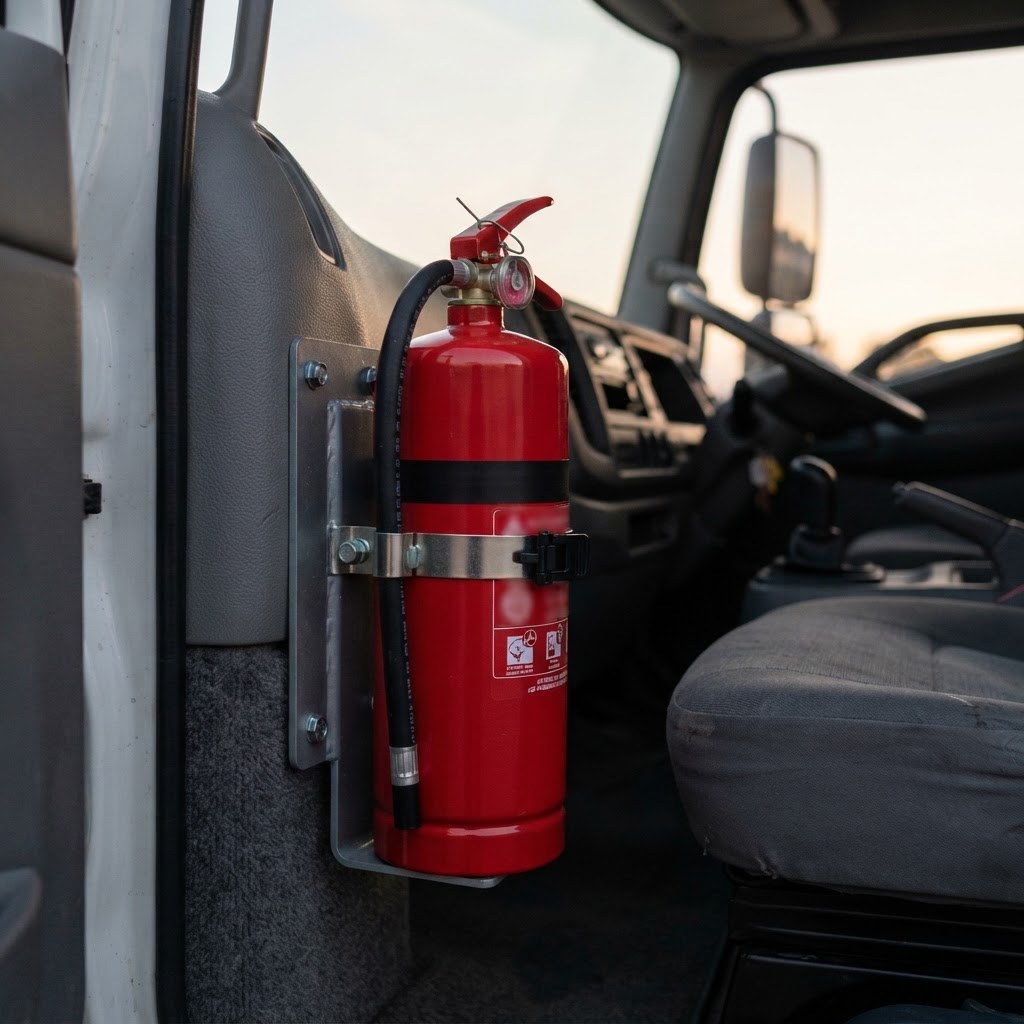
The ADG Code doesn’t just specify the type of extinguisher — it specifies where and how it must be mounted. Under Clause 12.1.2.4, each fire extinguisher must be mounted securely using a quick-release attachment. An extinguisher rolling around in the cab is non-compliant.
Key location rules:
- Cabin extinguisher: Must be readily accessible. May be located in the cabin, directly behind the cabin, or mounted on the rear of the cabin.
- Load area: If two or more extinguishers are required for the load area, one should be on the left (near) side towards the rear, and another on the right (off) side towards the front, wherever practicable.
- Road tank vehicles: Fire extinguishers must be stowed in accordance with AS 2809.1.
Extinguishers must also be maintained in serviceable condition under AS 1851 — inspected, tested and tagged at required intervals. An out-of-date extinguisher is the same as no extinguisher at a roadside check.
Common Compliance Failures
NSW EPA and NHVR roadside inspections frequently catch drivers out on fire extinguisher compliance. The most common failures are:
- Undersized extinguisher: Carrying a 10B (0.75kg) when a 30B (1.5kg) is required for packaged DG
- Not mounted: Extinguisher loose in the cab or tool box — must be on a quick-release bracket
- Out of test date: AS 1851 requires periodic inspection and tagging — expired tags mean non-compliance
- Wrong type: Foam or water extinguishers alone don’t meet DCP requirements — you need dry chemical powder as specified
- Missing cabin unit: For bulk loads, drivers forget the separate 10B cabin extinguisher in addition to the load area units
For a full breakdown of what every DG vehicle must carry — including fire extinguishers, warning devices and PPE — read our complete ADG Code fire extinguisher guide.
Maintenance and Service Requirements
Fire extinguishers on DG vehicles must be maintained under AS 1851 — the Australian standard for portable fire extinguisher servicing. This means:
- 6-monthly inspections: Visual check that the extinguisher is in place, accessible, and shows no signs of damage
- Annual service: More thorough inspection including pressure gauge check, seal verification and condition assessment
- 5-yearly test: Discharge test and recharge (or replacement) to verify the extinguisher still meets performance requirements
Every service must be recorded with a service tag attached to the extinguisher. At an NHVR or EPA roadside check, officers will look for a current tag. No tag, or an expired tag, means the extinguisher is non-compliant — regardless of whether it would actually work.
Make sure your fire extinguishers meet ADG Code requirements. Kells Safety Centre (RTO 91528) stocks the full range of compliant ABE dry chemical powder extinguishers with mounting brackets. Need your DG licence? Book the TLILIC0001 course at Wetherill Park or Wollongong.
Frequently Asked Questions
What B-rating fire extinguisher do I need for a DG vehicle in NSW?
It depends on your load. For packaged DG and non-flammable IBCs up to 10,000L, you need 1 x 30B DCP in the cabin (a 1.5kg ABE). For non-flammable bulk goods in tanks, you need 1 x 60B DCP plus 1 x 10B DCP in the cabin. For flammable bulk goods in tanks or large IBCs, you need 2 x 60B DCP, or 1 x 80B DCP plus 1 x 20B foam, in the load area, plus 1 x 10B DCP in the cabin. Check ADG Code Table 12.1 for your specific load.
What does the B rating on a fire extinguisher mean?
The B rating indicates the extinguisher’s firefighting capacity against Class B flammable liquid fires. The number represents the size of the test fire used during certification to AS/NZS 1850. A 30B rating means the extinguisher can suppress a larger flammable liquid fire than a 10B unit. Higher numbers mean more firefighting capacity. B-ratings range from 2B to 80B for portable extinguishers.
Is a 1.5kg fire extinguisher enough for a dangerous goods truck?
A 1.5kg ABE dry chemical powder extinguisher (30B rating) is the minimum requirement for vehicles carrying packaged dangerous goods or non-flammable IBCs up to 10,000L. However, if you’re carrying bulk goods in tanks or pressure vessels, you need additional extinguishers — typically a 4.5kg (60B) or 9kg (80B) for the load area, plus a 0.75kg (10B) in the cabin.
What is the difference between 60B and 80B fire extinguishers?
A 60B rating is typically a 4.5kg ABE dry chemical powder extinguisher, while an 80B is typically a 9kg ABE. The 80B can suppress a larger flammable liquid fire. Under the ADG Code, flammable bulk loads in tanks require 2 x 60B, or 1 x 80B plus 1 x 20B foam, in the load area. Some operators prefer a single larger unit for simplicity; others prefer two smaller units for redundancy.
Do I need a fire extinguisher in the cab and the load area?
For packaged DG loads, only one 30B extinguisher is required, typically in the cabin. For bulk loads (tanks, pressure drums, MEGCs), you need separate extinguishers for the cabin (10B) and the load area (60B or 80B). The ADG Code Clause 12.1.2.5 specifies that the cabin extinguisher may alternatively be mounted directly behind or on the rear of the cabin.
How often must DG vehicle fire extinguishers be serviced?
Fire extinguishers on dangerous goods vehicles must be serviced under AS 1851. This includes 6-monthly visual inspections, annual service with pressure and seal checks, and a 5-yearly discharge test. Each service must be recorded on a tag attached to the extinguisher. An expired or missing service tag means non-compliance at a roadside check.
Can I use a foam extinguisher instead of dry chemical powder on a DG vehicle?
Dry chemical powder (DCP) is the primary requirement under the ADG Code. For flammable bulk loads, the alternative to two 60B DCP units is one 80B DCP plus one 20B foam unit in the load area. However, foam alone does not satisfy the DCP requirement. If more than one DCP is required in the load area, one may be replaced with a 9L foam or water extinguisher, but at least one DCP must remain.
What happens if my fire extinguisher is not mounted properly?
Under ADG Code Clause 12.1.2.4, every fire extinguisher must be mounted securely with a quick-release attachment. An unmounted extinguisher — even the correct type and size — is non-compliant. At an NHVR or EPA roadside inspection, this will be recorded as a deficiency. Extinguishers must also be readily accessible for use, not stored in toolboxes or behind cargo.
Where can I buy ADG Code-compliant fire extinguishers in NSW?
Kells Safety Centre stocks the full range of ABE dry chemical powder extinguishers — 1.5kg (30B), 4.5kg (60B) and 9kg (80B) — with mounting brackets and AS/NZS 1841 certification. Browse our safety equipment range or visit our Wetherill Park training centre. All extinguishers are ready for in-service use on DG vehicles.
Does the DG licence course cover fire extinguisher requirements?
Yes. The TLILIC0001 dangerous goods licence course covers ADG Code requirements including fire extinguisher specifications, equipment requirements, and safety equipment obligations. Kells Safety Centre (RTO 91528) delivers this course at Wetherill Park and Wollongong, or online. View all training courses to find upcoming dates.