
Quick Summary
Dangerous goods vehicle marking in NSW requires three things on every placard load vehicle: class labels showing the hazard class, a hazchem placard with the Emergency Action Code (EAC), and an Emergency Information Panel (EIP) displaying the proper shipping name, UN number, and hazchem code. These markings are mandatory under the ADG Code for any vehicle transporting a placard quantity of dangerous goods in NSW. Failing to correctly mark a DG vehicle carries penalties under the NSW Dangerous Goods (Road and Rail Transport) Regulation and can result in the vehicle being grounded until corrected.
Key Takeaways
- Three mandatory markings: Class labels, hazchem placard, and Emergency Information Panel (EIP)
- Placard load threshold: Marking is required when the load exceeds the placard quantity for any DG class
- EIP placement: Must be visible on both sides of the vehicle, readable from a safe distance
- Class label size: Minimum 250mm x 250mm for most vehicles, 100mm x 100mm for smaller units
- Penalties: Failure to mark carries fines under NSW DG transport regulations
- Who is responsible: The consignor, consignee, and vehicle operator all share marking obligations under Chain of Responsibility
What Are Dangerous Goods Vehicle Marking Requirements in NSW?
Dangerous goods vehicle marking requirements in NSW are governed by the Australian Dangerous Goods (ADG) Code, which sets out exactly how a vehicle transporting dangerous goods must be marked to allow emergency services to quickly identify the hazards on board. The requirements apply to any road vehicle carrying a placard quantity of dangerous goods — the threshold above which the load is large enough to require full hazard marking.
The marking system has one purpose: if an emergency occurs on the road, first responders must be able to identify the dangerous goods, the hazard class, and the correct emergency response action without opening the vehicle or making contact with the load. Every element of the marking — class labels, hazchem placard, and EIP — feeds that response.
In NSW, the ADG Code is enforced by the NSW EPA and Safe Work NSW, working alongside NHVR for heavy vehicle compliance. Drivers transporting dangerous goods must hold a current dangerous goods licence (TLILIC0001) issued by a registered training organisation such as Kells Safety Centre (RTO 91528).
What Markings Does a DG Vehicle Need?
A vehicle carrying a placard load of dangerous goods must display three core markings:
1. Class Labels (Diamond-Shaped Hazard Labels)
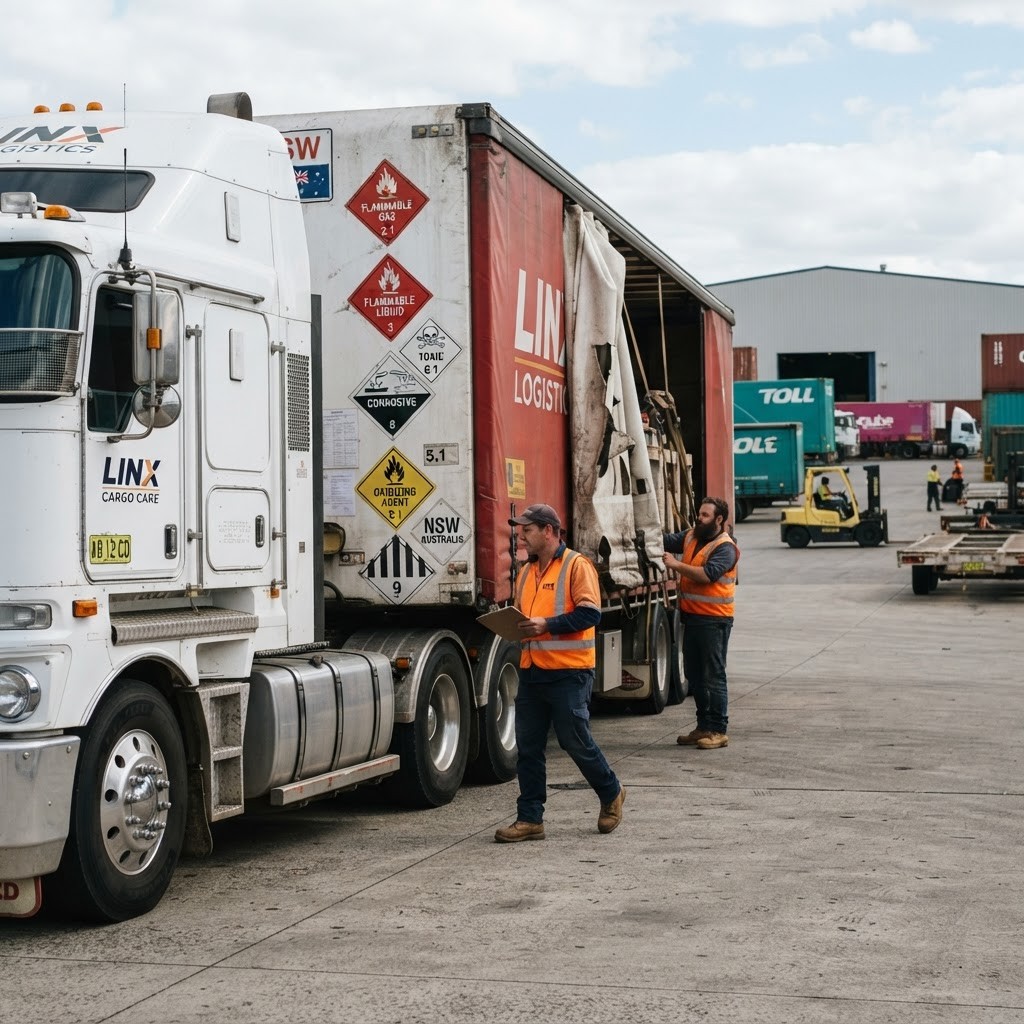
Class labels are the diamond-shaped hazard signs corresponding to the 9 dangerous goods classes defined in the ADG Code. Each class has a distinct colour and symbol:
- Class 1: Explosives (orange diamond)
- Class 2.1: Flammable gases (red diamond, flame symbol)
- Class 2.2: Non-flammable, non-toxic gases (green diamond)
- Class 2.3: Toxic gases (white diamond, skull symbol)
- Class 3: Flammable liquids (red-white diamond, flame symbol)
- Class 4: Flammable solids, spontaneously combustible, dangerous when wet (red/white striped)
- Class 5: Oxidising substances and organic peroxides (yellow diamond)
- Class 6: Toxic and infectious substances (white diamond)
- Class 7: Radioactive material (yellow/white diamond, trefoil symbol)
- Class 8: Corrosive substances (black/white diamond, hand/corrosion symbol)
- Class 9: Miscellaneous dangerous goods (black/white striped diamond)
Class labels must be displayed on both sides and at the rear of the vehicle or load. Minimum dimensions are typically 250mm x 250mm for large vehicles, though smaller minimums apply to certain load configurations.
2. Hazchem Placard (Emergency Action Code)
The hazchem placard displays the Emergency Action Code (EAC), a three-character code that tells emergency services what response action to take. The code indicates:
- First character: The type of extinguishing medium (water jet, water fog, foam, dry agent)
- Second character: Whether the substance is toxic, can be violently reactive, or requires protective equipment
- Third character: Whether the substance can be diluted or contained, and evacuation considerations
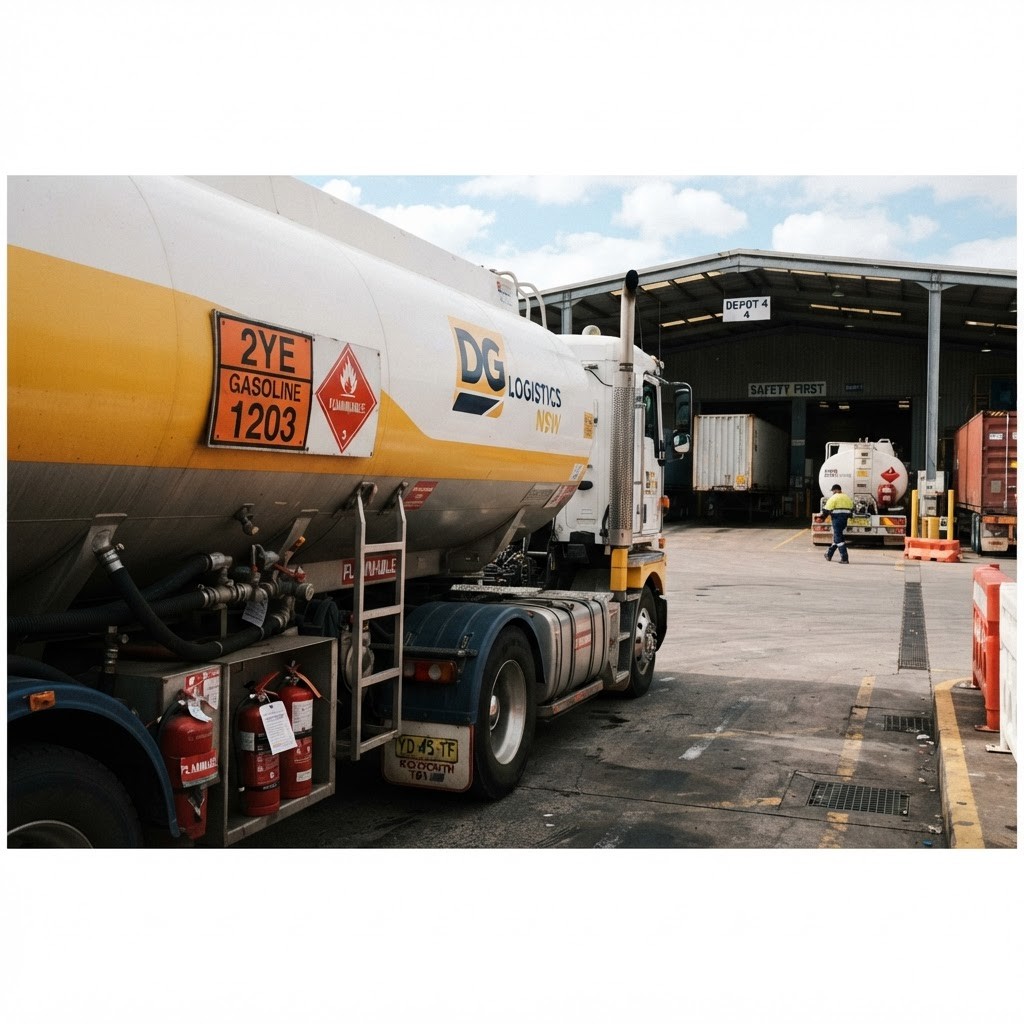
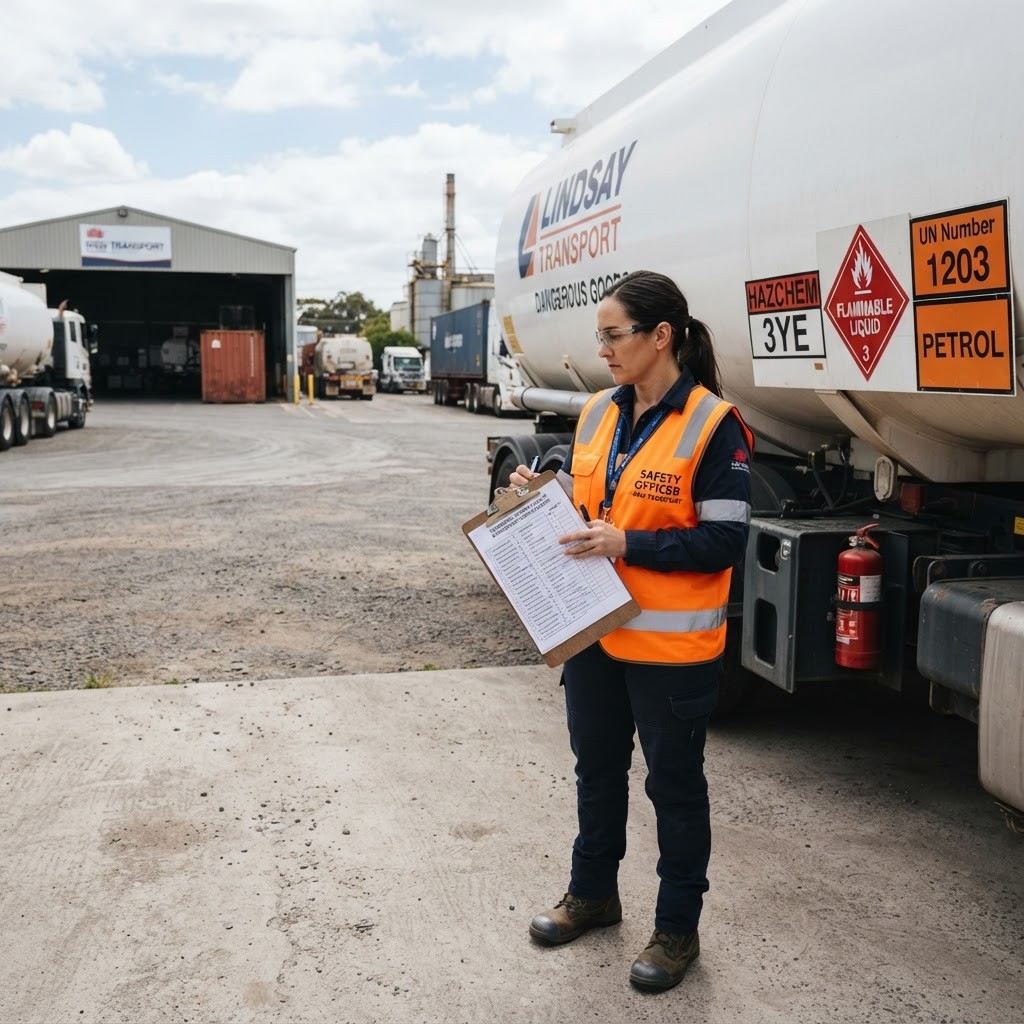
For example, a hazchem code of 2YE means: use fine water spray (2), the substance is toxic and requires breathing apparatus (Y), and public safety hazard exists — consider evacuation (E). The hazchem placard is normally orange with black text and must be clearly visible.
3. Emergency Information Panel (EIP)
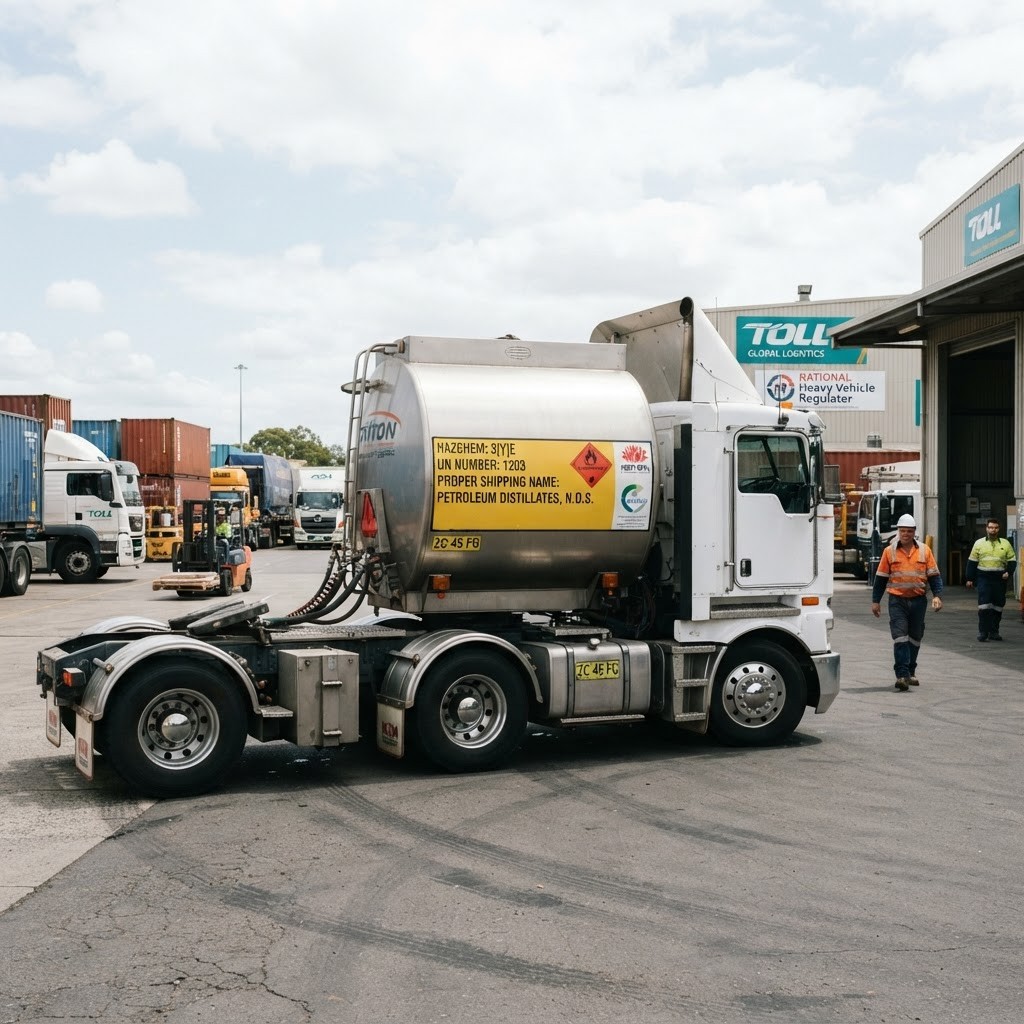
The Emergency Information Panel (EIP) is the primary identification panel for the load. It must display:
- Proper shipping name of the dangerous goods
- UN number of the substance
- Hazchem code (Emergency Action Code)
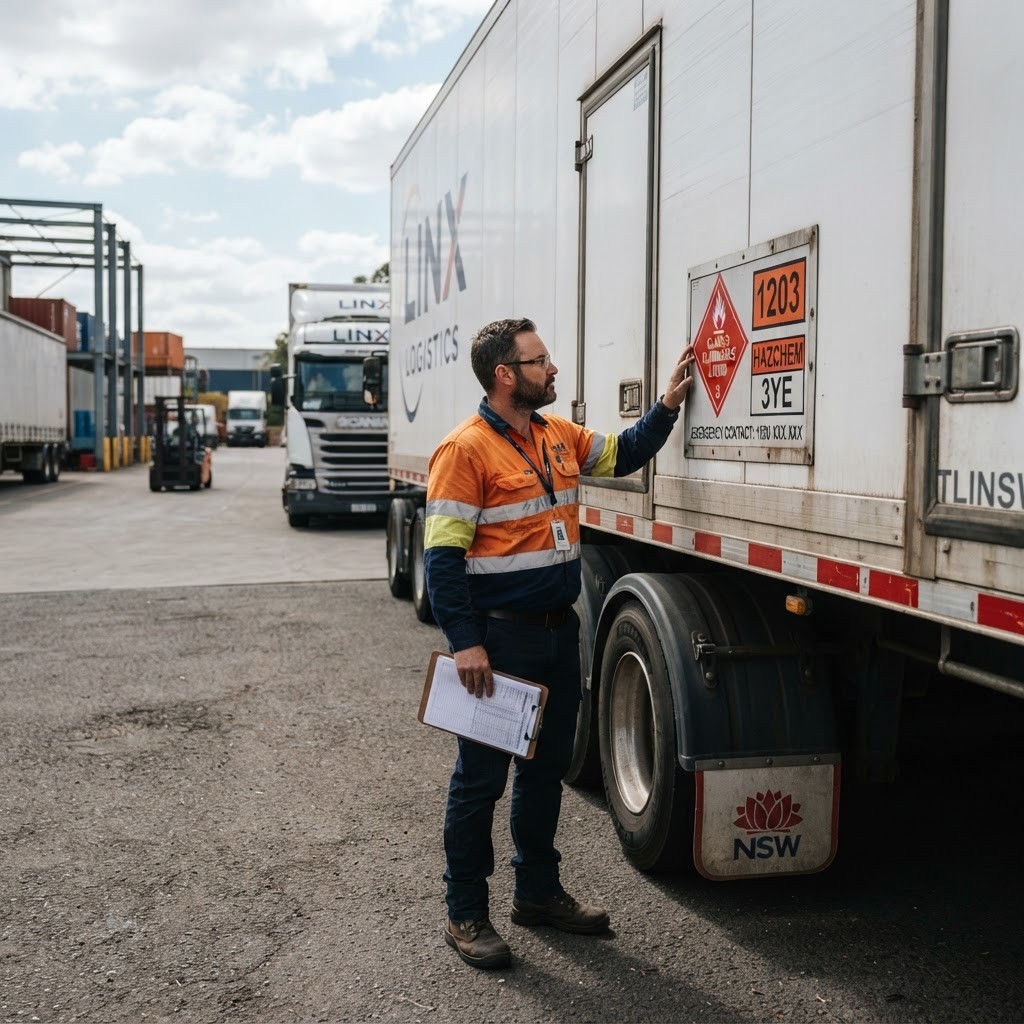
The EIP must be mounted on both sides of the vehicle in a position that is readable from a safe distance — typically at eye level or above the load line. For mixed loads, an EIP is required for each dangerous goods class on the vehicle. EIP panels are available in several formats including metal panels, self-adhesive panels, and interchangeable panel systems — see our EIP panel types comparison guide for details.
When Is a Vehicle Required to Be Marked?
A vehicle must be marked when it carries a placard quantity of dangerous goods. The placard quantity threshold varies by class and packing group:
| DG Class | Typical Placard Quantity Threshold |
|---|---|
| Class 2.1 (flammable gas) | 1,000 L (bulk) or 1,000 kg |
| Class 3 (flammable liquid, PG II) | 1,000 L |
| Class 3 (flammable liquid, PG III) | 5,000 L |
| Class 8 (corrosive, PG II) | 1,000 kg |
| Class 5.1 (oxidising, PG II) | 1,000 kg |
These thresholds are set in the ADG Code and are the point at which a load transitions from a packaged dangerous goods shipment to a placard load. Below the threshold, packaged DG must still be labelled and documented, but full vehicle marking is not required. You can use our placard load calculator to work out whether your load meets the threshold.
In practical terms, most tankers and bulk transport vehicles carrying dangerous goods in NSW will be above the placard quantity — so marking is the default, not the exception.
Where Must DG Markings Be Positioned on the Vehicle?
The ADG Code specifies where each marking element must be placed on the vehicle:
- Class labels: One on each side of the vehicle and one at the rear. For multi-compartment tankers, each compartment must show its own class label if it contains a different class.
- Hazchem placard: Displayed on both sides and at the front of the vehicle, clearly visible to emergency services approaching from either direction.
- EIP: One on each side of the vehicle, positioned so the information is readable from at least 10 metres. The EIP must not be obscured by tarps, doors, or equipment.
- Rear of vehicle: The rear class label must be positioned so it is visible from behind, not blocked by tailgates, ramps, or mounted equipment.
The key principle is visibility from a safe distance. Emergency services must be able to read the EIP and identify the class label without approaching the vehicle closely. If markings are faded, damaged, or obscured, the vehicle should not proceed until they are restored.
Who Is Responsible for Vehicle Marking?
Under the Chain of Responsibility (CoR) provisions in the Heavy Vehicle National Law, multiple parties share the obligation to ensure correct vehicle marking:
- The consignor (the business sending the goods) must confirm the goods are properly classified, packaged, and that the vehicle is correctly marked before the load departs.
- The vehicle operator must ensure the vehicle has the correct class labels, EIP, and hazchem placard fitted and maintained.
- The driver must check that all markings are in place, legible, and not obscured before driving, and during the journey.
- The consignee (the business receiving the goods) must not accept a load where marking is incorrect or missing.
All parties can be held liable if a vehicle is found on the road with missing or incorrect DG markings. This means a business that merely consigns dangerous goods can face penalties if the vehicle they engage is improperly marked — even if they do not own the vehicle.
What Happens If a Vehicle Is Not Properly Marked?
Operating a DG vehicle without correct marking is a breach of the ADG Code and NSW dangerous goods transport regulations. Consequences include:
- Fines: Penalty notices can be issued by the NSW EPA, NSW Police, or NHVR inspectors
- Vehicle grounding: The vehicle may be directed to stop and not proceed until markings are corrected
- Load seizure: In serious cases, the load may be seized or required to be transferred to a compliant vehicle
- CoR liability: Consignors and operators can face prosecution even if the driver was not aware of missing markings
- Insurance risk: An accident involving an improperly marked DG vehicle can void or reduce insurance cover
The most common deficiency is not a missing marking but a faded or illegible one. Class labels and EIP panels degrade with sun exposure, and a partially legible EIP is effectively no EIP. Operators should inspect markings as part of pre-departure checks and replace panels that are no longer fully readable.
What Safety Equipment Should a Placard Vehicle Carry?
Beyond markings, a vehicle transporting a placard load must also carry specific safety equipment. The requirements depend on the DG class and hazchem code, but typically include:
- Fire extinguisher — at least one, suited to the DG class carried (see our DG fire extinguisher size guide)
- Spill kit — appropriate to the DG class, for immediate containment
- PPE — gloves, eye protection, and respiratory protection as specified by the hazchem code
- Emergency procedures guide — the current edition, carried in the cab
- Vehicle emergency kit — including warning triangles and high-visibility equipment
Replacement DG placards, class labels, and EIP panels are available from the Kells Safety Centre safety equipment shop, so drivers can carry spares and replace damaged markings on the road if needed.
FAQ — Dangerous Goods Vehicle Marking NSW
What size do class labels need to be on a DG vehicle in NSW?
Class labels for dangerous goods vehicles in NSW must be a minimum of 250mm x 250mm for standard heavy vehicles. Smaller minimums (100mm x 100mm) apply to certain load configurations and smaller transport units. The label must be a true diamond shape with the correct colour and symbol for the DG class carried.
Does every DG vehicle need an Emergency Information Panel?
Every vehicle carrying a placard quantity of dangerous goods must display an EIP showing the proper shipping name, UN number, and hazchem code. If the vehicle carries mixed loads of different DG classes, an EIP is required for each class. Vehicles carrying below-threshold packaged DG do not require an EIP but must still have correct package labelling and documentation.
Can I use self-adhesive DG placards or do they need to be metal?
Both metal and self-adhesive DG placards are acceptable under the ADG Code, provided they meet the size, colour, and legibility requirements. Self-adhesive panels are commonly used for fixed-route operations, while metal or interchangeable panel systems suit mixed-load operations where the DG class changes between trips. The key is that the panel must be clearly readable from a safe distance at all times.
Who checks DG vehicle markings during a roadside inspection?
Roadside DG marking inspections are carried out by NSW Police, NSW EPA officers, and NHVR compliance inspectors. They check that class labels, hazchem placards, and EIP panels are present, correctly positioned, and legible. They may also verify that the markings match the dangerous goods transport document and the actual load on the vehicle.
What is the difference between a class label and a hazchem placard?
A class label is a diamond-shaped hazard sign that identifies the type of hazard (flammable, toxic, corrosive, etc.) by its class number, colour, and symbol. A hazchem placard displays the Emergency Action Code (EAC), a three-character code that tells emergency responders the correct firefighting medium, PPE requirements, and evacuation actions. Both are mandatory on a placard load vehicle, but they serve different purposes in the emergency response chain.
Do I need a dangerous goods licence to drive a marked DG vehicle?
Yes. In NSW, a driver transporting a placard quantity of dangerous goods must hold a current dangerous goods licence issued under TLILIC0001. The licence is obtained by completing a course with a registered training organisation such as Kells Safety Centre (RTO 91528). Drivers who only carry below-threshold packaged DG may not need the licence, but should still complete DG awareness training to understand their obligations.
Are DG vehicle markings required for interstate transport?
Yes. The ADG Code applies nationally, so DG vehicle marking requirements are consistent across all Australian states and territories. A vehicle that is correctly marked for NSW is also correctly marked for Victoria, Queensland, and other states. However, drivers should check if any state-specific permits or notifications are required for certain dangerous goods classes in the states they transit.
How often should DG markings be replaced?
DG markings should be inspected before every journey as part of pre-departure checks. Class labels, hazchem placards, and EIP panels should be replaced immediately if they are faded, torn, peeling, or illegible. Sun exposure and road conditions degrade markings over time — a typical replacement cycle is 12–24 months for vehicles in regular DG service, but panels mounted on the load-side may need more frequent replacement due to chemical exposure.
Get Trained in DG Transport Compliance
Kells Safety Centre (RTO 91528) delivers the full range of dangerous goods transport courses in NSW, including the TLILIC0001 licence, Prepare for Transport, and DG Awareness training. View All Training Courses and Book Online